
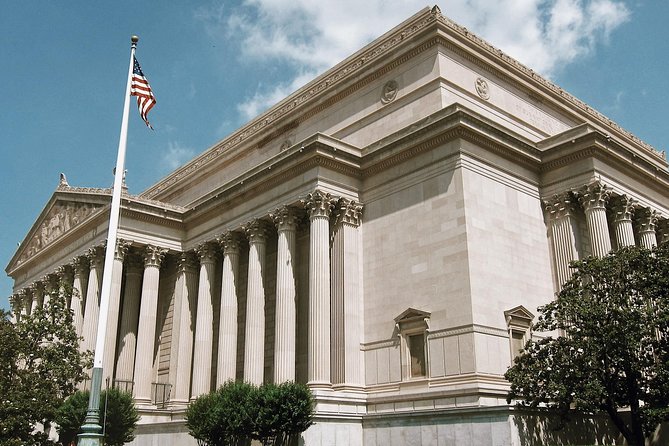
Reviewed · NATIONAL ARCHIVES
Skip-the-line National Archives Building Exclusive Guided Tour
The most powerful moment here is also the simplest: you stand a few feet from the original Declaration of Independence, Constitution, and Bill of Rights. The dim Rotunda, the enormous marble walls, and the aging ink on those pages make American political ideals feel less like textbook material and more like fragile, human work.
I like the way a good guide turns a short museum visit into a connected story, moving from the Magna Carta to the founding documents and then to letters from George Washington and John F. Kennedy. I also like the small-group format, with no more than eight people, which gives guides such as Annemarie, Donna, Ryan, Meghan, and Kate room to answer questions and adjust the pace.
The main drawback is that the quality depends on your guide and the crowd. Some guides keep families engaged and moving; others may talk for long stretches, move too quickly, or leave too little time to inspect nearby displays. At $105.73 per person, this is a premium add-on to a museum with free admission, so you should book it for interpretation and navigation, not simply entry.
In This Review
- Key points to know before you book
- Why the National Archives feels different from another museum
- Inside the Rotunda with the founding documents
- The Public Vaults and the people behind the pages
- The Rubenstein Gallery and the Magna Carta
- What the guides add to the visit
- Is $105.73 a fair price?
- Timing, security, and practical details
- Who will get the most from this tour?
- Should you book the National Archives guided tour?
- FAQ
- Where does the National Archives guided tour begin?
- Where does the tour end?
- How long does the tour last?
- How much does the experience cost?
- What documents will I see?
- Will I see letters from famous American leaders?
- Is admission to the museum included?
- Is the tour wheelchair accessible?
- How many people can join the tour?
- Can I cancel for a full refund?
Key points to know before you book
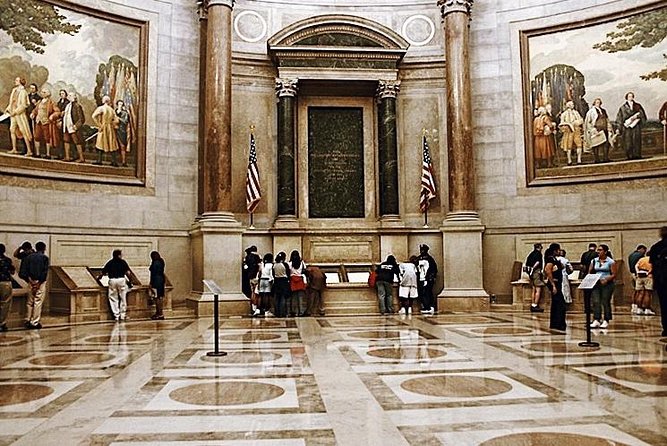
- See the original founding documents: The Rotunda holds the Declaration of Independence, Constitution, and Bill of Rights, not just reproductions.
- A guide connects the dots: The route links the Magna Carta of 1297, the Federalist Papers, the Emancipation Proclamation, and presidential letters.
- Small groups matter: A maximum of eight people makes it easier to hear, ask questions, and move through crowded rooms.
- Plan for about two hours: The visit covers the Rotunda, Public Vaults Exhibits, and Rubenstein Gallery.
- Expect a premium price: Museum admission is free, but the $105.73 fee pays for a private guided experience and help navigating security and crowds.
- Check the booking option carefully: The private version includes an exclusive guide and wheelchair access, while the save-money semi-private option does not include either feature.
Why the National Archives feels different from another museum
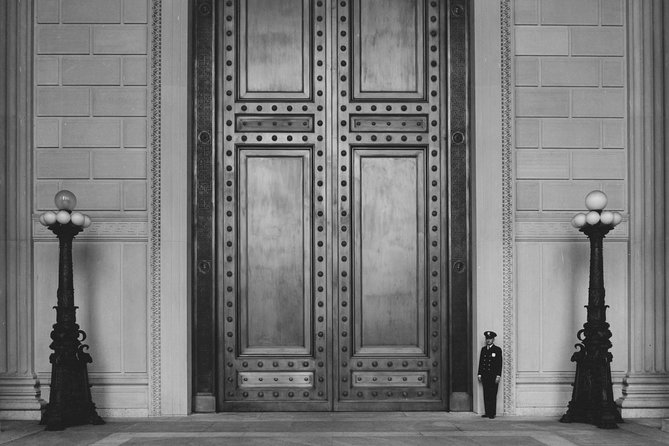
Washington has plenty of grand buildings, but the National Archives is unusually focused. You are not mainly looking at paintings, statues, or objects removed from their original setting. You are looking at paper: pages that helped define a country and still shape its public life.
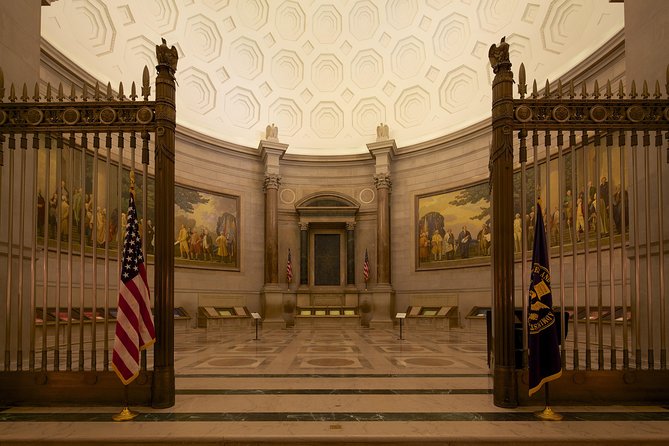
That sounds modest until you see the documents in the Rotunda. The Declaration of Independence, Constitution, and Bill of Rights are displayed in a darkened, formal room designed to make you slow down. The handwriting is old and sometimes hard to read. That is part of the point. These were working documents, written, argued over, signed, copied, and stored. They are not polished symbols floating above real life.
I find a guide especially useful here because the museum can otherwise become a quick stop for photographs. You can see the cases in a few minutes and leave knowing you saw the big three. A strong guide gives you the backstory: what each document was trying to solve, how the language was shaped, and why the pages still matter.
This is also a good place for a guide to add context about the neoclassical building itself. The architecture presents the documents almost like sacred objects, a deliberate choice for a country that treats its founding papers as a civic foundation. You may appreciate the building more once you understand that design decision.
More National Archives tours:
- VIP Best of DC with US Capitol + National Archives Reserved Entry
★ 4.5 · 2,491 reviews - National Archives Skip the Line Guided Tour Semi-Private 6ppl Max
★ 5.0 · 196 reviews - VIP National Archives Skip-The-Line Guided Tour 6 ppl Max
★ 5.0 · 126 reviews
Inside the Rotunda with the founding documents
The tour begins at the National Archives Museum, 701 Constitution Avenue NW. After entry and security, your guide leads you to the Rotunda, the emotional center of the visit.
The Declaration of Independence is usually the first document people look for. You may already know its famous opening lines, but seeing the original page changes the experience. The ink has faded, the script is compact, and the page looks surprisingly vulnerable. Your guide can help place it in the political crisis that produced it rather than treating it as a single famous quotation.
The Constitution is a different kind of object. Instead of announcing a break from a government, it establishes the structure of one. This is where the tour can help you notice the practical side of the founding era: how power was arranged, how authority was divided, and how the document became the basis for later arguments.
The Bill of Rights brings the story closer to everyday life. Its amendments concern speech, religion, legal protections, and the relationship between citizens and government. A guide can point out how these short provisions became part of later American debates.
The Federalist Papers may also enter the conversation here. They help explain the arguments used to defend the Constitution and show that the founding period was not a neat moment of agreement. That extra layer is valuable. It reminds you that the United States was created through dispute and persuasion, not through one perfectly shared plan.
The Rotunda can be crowded, and quiet rules apply in some areas. Your guide may need to speak softly or explain information before you enter a room. You should expect some standing, though the overall private tour is wheelchair friendly when you choose the applicable option.
The Public Vaults and the people behind the pages
After the Rotunda, the route continues to the Public Vaults Exhibits. This section broadens the story beyond the best-known founding papers.
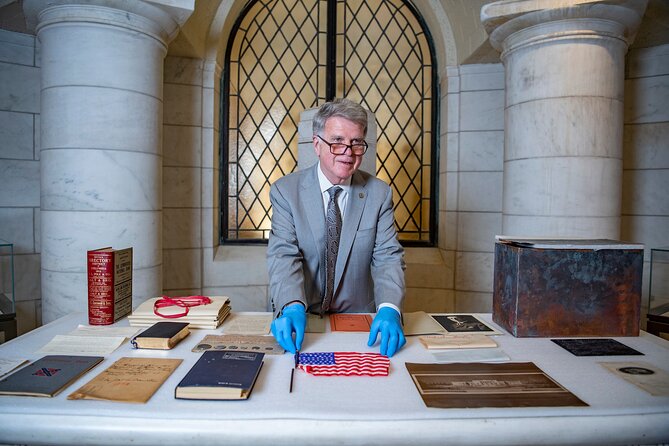
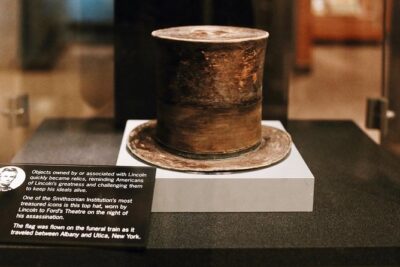
Here, you may see letters from George Washington and John F. Kennedy. Those letters help put famous leaders back into human scale. A constitutional page can feel remote and official. A letter, with its personal voice and immediate purpose, shows how public decisions were made by real people responding to specific problems.
The Emancipation Proclamation is another major stop. Issued in 1863, it helped change the legal and political course of the Civil War and led toward the abolition of slavery. Seeing it alongside the founding documents invites a harder reading of American history. The ideals proclaimed in the earlier papers existed beside slavery, exclusion, and conflict. A good guide should not smooth over that tension.
This part of the museum is also where navigation becomes useful. The Archives holds more material than you can absorb in one pass. Guides such as Meghan and Annemarie have been praised for moving groups through crowded rooms while directing attention to the most important displays. That can save time, especially if you have only one visit to Washington.
Still, there is a tradeoff. A guide has to choose what to emphasize. If you want to inspect every case at your own speed, a private tour may feel restrictive when the guide gathers you for a long explanation. One reported experience found too much standing and too little time to explore surrounding exhibits. That is a fair concern, particularly for independent museum visitors who prefer to read every label.
You can improve the fit by telling your guide early what interests you most. Ask for more time with the presidential letters, the founding papers, or the exhibits that concern civil rights. The private format should make that kind of adjustment possible, though the tour still follows a set route.
The Rubenstein Gallery and the Magna Carta
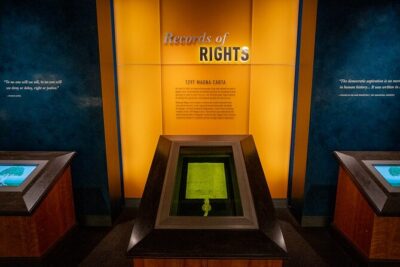
The final major section is the Rubenstein Gallery, where the Magna Carta of 1297 provides a much older starting point for American constitutional ideas.
The document predates the United States by centuries. Its presence helps explain that American government did not appear from nowhere. Ideas about limits on rulers, legal rights, and written agreements developed over a long period and were adapted in new settings.
The Magna Carta is not an American founding document, and it should not be treated as a direct blueprint for the Constitution. Its value here is as part of a longer chain of political thought. Your guide can help separate the legend from the actual document and show why later generations regarded it as important.
This gallery also gives the tour a useful ending. You begin with documents connected to the creation of the United States, then see later papers and personal letters, and finally look farther back at an earlier source of constitutional thinking. The route encourages you to consider the country as an unfinished argument rather than a story that ended in 1787 or 1791.
Collections and displays can change during the year. If you have your heart set on one particular item beyond the major documents listed here, treat it as a possibility rather than a guarantee.
A few more Washington DC tours worth a look
- National Archives Skip-the-Line Guided Tour
★ 5.0 · 85 reviews - National Archives Skip the Line Tour Semi-Private 6ppl Max
★ 4.9 · 76 reviews - Skip the Line National Archives and US Capitol Tour
★ 4.5 · 51 reviews
What the guides add to the visit
The strongest part of this experience is the guide’s storytelling. Annemarie has been praised for combining detail about the founding papers with information about the paintings and the building. Donna is noted for a warm, personal approach and for making the roughly two-hour route feel quick. Ryan brings strong local knowledge of Washington along with academic training in history and biology.
Meghan is a particularly practical choice for families. Her style has kept children aged seven and nine engaged, and she has been praised for handling questions and back-and-forth discussion with ease. Kate is described as energetic and playful in her delivery, which can help younger visitors or anyone who finds formal museum talks dry.
Those names are useful when selecting a guide if the booking system lets you do so, but guide assignments can vary. The larger point is that the experience works best with a guide who treats the visit as a conversation, not a speech.
You should also be clear about what you want. Ask questions as you go. If you need more time to look at a case, say so. If you are visiting with children, mention their ages. If the group includes someone who needs a slower pace, raise that before the tour begins.
Some guides are praised for answering unusual questions and adding advice about other things to see in Washington. That broader local knowledge can make the tour more useful than a document-by-document talk. You are not only learning what is in the cases, but also how the Archives fits into a day of sightseeing around the National Mall.
Is $105.73 a fair price?
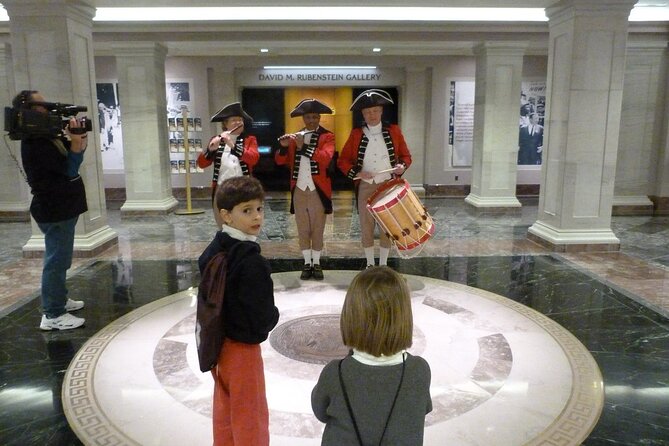
The museum admission itself is listed as free, so the price requires an honest look. At $105.73 per person, you are paying for a guide, a small private group, help getting through the building efficiently, and interpretation that turns a short museum stop into a structured experience.
For a couple, the total cost is significant. For a family of four, it adds up quickly. If you enjoy reading labels on your own and already know the basics of the founding documents, you may prefer to visit independently and keep the money for another Washington attraction.
I think the price makes more sense in three situations. First, you have limited time and want to see the key rooms without wandering. Second, you are visiting with children or teenagers who need a story and some interaction to stay involved. Third, you care about the political and legal background and want to ask questions rather than simply view the cases.
The maximum group size of eight helps protect the value. This is not a huge lecture where you stand at the back and struggle to hear. The private version gives your party its own guide, which is useful for families and small groups with shared interests.
There is also a cheaper semi-private option. Read the conditions closely: the exclusive guide and wheelchair-friendly provision do not apply to that save-money choice. If access or a fully private setting matters, the lower price may not be the right bargain.
Timing, security, and practical details
Allow between 90 minutes and two hours. The published schedule gives two hours as an approximate duration, but the actual pace can depend on crowds, questions, security, and how much time your guide spends in each gallery.
The meeting point is the National Archives Museum at 701 Constitution Avenue NW. The museum is near public transportation. Hotel pickup and drop-off are not included, and the operator recommends using a taxi or Uber if that suits your plans.
Bring only what you need. Large bags and suitcases are not allowed inside. Handbags and small, thin backpacks can pass through security, but increased security measures can still create lines, even with skip-the-line access. In plain terms, skip-the-line does not mean you can ignore screening.
Dress appropriately for entry into some sites on the tour. The museum may close occasionally without warning, and other Washington attractions can do the same. If the museum opening is delayed by more than an hour, an alternative may be offered, but the conditions state that refunds or discounts are not available in these cases.
The activity ends back at the museum meeting point. It is a private activity, with only your group participating, unless you choose the semi-private option.
Free cancellation is available if you cancel at least 24 hours before the start time. Inside that window, the amount paid is not refunded, and changes are not accepted. That deadline uses local Washington time.
Who will get the most from this tour?
I would choose this for a first visit to Washington, especially if the National Archives is one of your priorities. It gives you a clear route through the most important material and prevents the founding documents from becoming a five-minute photo stop.
Families are a strong match. The subject can sound dry to children, but a guide who tells stories, asks questions, and keeps moving can make the papers approachable. The small group also lets you explain your children’s attention span and interests at the start.
History and government enthusiasts will appreciate the connections among the Magna Carta, Federalist Papers, Constitution, Bill of Rights, and later documents. The tour is also useful for visitors who want more than the standard patriotic version of the story, since the Emancipation Proclamation and later political documents add conflict and change to the picture.
You may not need it if you are a patient museum reader, want complete freedom to linger, or have already visited the Archives several times. In that case, free admission and your own route may offer better value.
Should you book the National Archives guided tour?
Book it if you want the original founding papers explained by an expert, need help making the most of limited time, or are traveling with children who benefit from a lively narrator. The best guides, including Annemarie, Donna, Ryan, Meghan, and Kate, can make the museum feel personal and keep the story moving.
Think twice if the price feels high for a museum with free admission, or if you dislike standing while someone gives a long talk. The experience is guide-dependent, and some styles are faster and more lecture-heavy than others.
My practical choice would be the private version for a first visit, with a small group and clear requests about pace and interests. Arrive ready for security, carry a small bag, and leave room for the possibility that crowds will shape the route. If those conditions suit you, this is one of the more useful ways to see the National Archives, because you leave with a sense of how the documents connect, not just a picture of each famous page.
FAQ
Where does the National Archives guided tour begin?
The tour begins at the National Archives Museum, 701 Constitution Avenue NW, Washington, DC 20408.
Where does the tour end?
The activity ends back at the National Archives Museum meeting point.
How long does the tour last?
The tour lasts approximately 1.5 to 2 hours.
How much does the experience cost?
The listed price is $105.73 per person.
What documents will I see?
The tour includes the original U.S. Constitution, Declaration of Independence, and Bill of Rights. It also covers the Magna Carta, Federalist Papers, the Emancipation Proclamation, and historic letters.
Will I see letters from famous American leaders?
Yes. The route includes letters from George Washington, John F. Kennedy, and other leaders.
Is admission to the museum included?
The itinerary lists museum admission as free. The tour price covers the guided museum experience rather than a separate admission charge.
Is the tour wheelchair accessible?
The private tour is wheelchair friendly. This provision does not apply if you choose the save-money semi-private option.
How many people can join the tour?
A maximum of eight people is permitted per tour. The activity is private unless you select the semi-private option.
Can I cancel for a full refund?
Yes. You can receive a full refund if you cancel at least 24 hours before the experience start time. Cancellations or changes made within 24 hours are not refunded or accepted.
Recently added around Washington DC
- Small Group Washington DC Night Tour★ 4.5 · 3 reviews
- Washington DC Neighborhoods Personalized Self-Guided App Tour★ 3.5 · 3 reviews
- America’s Main Street and White House Private Full-Day Tour★ 5.0 · 3 reviews
- Beyond the Closet Walking Tour★ 5.0 · 3 reviews
- Pirate Ship Treasure Hunt Cruise with Face Painting★ 4.5 · 3 reviews
- Sushi Masterclass in Washington D.C. (Includes 4-Course Meal)★ 5.0 · 3 reviews
- Private Washington DC Grand Tour with Changing of the Guard.★ 5.0 · 3 reviews
- 250th: National Archives & American History Museum Guided Tour★ 5.0 · 3 reviews
National Archives, compared.

VIP Best of DC with US Capitol + National Archives Reserved Entry
Read our review →
National Archives Skip the Line Guided Tour Semi-Private 6ppl Max
Read our review →
VIP National Archives Skip-The-Line Guided Tour 6 ppl Max
Read our review →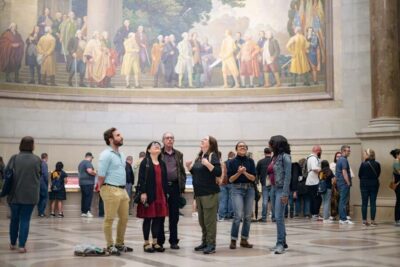
National Archives + American History Museum Tour 8ppl Max
Read our review →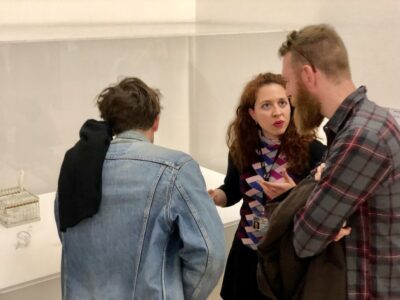
National Archives Skip the Line Tour Semi-Private 6ppl Max
Read our review →
Skip the Line National Archives and US Capitol Tour
Read our review →Browse the lists this tour appears in