Reviewed · TOURS
Off the Beaten Path: 16th Street and Adams Morgan Neighborhood Tour
Washington DC’s grand monuments tell the official story. This two-hour walk looks at the city through its neighborhoods, where ambitious plans, grand facades, local quirks, and shifting identities meet. You begin at Meridian Hill Park, then make your way toward Columbia Heights and Adams Morgan, finishing near 18th Street and Kalorama Street.
I like the focus on architecture and human stories, rather than a fast roll call of facts. I also like that the tour works for people who already know Washington well. Local residents have taken it and still learned about their own streets, including the role of Mary Henderson and the way buildings changed use over time.
The main consideration is the pace. You cover a lot on foot in about two hours, and the tour requires a moderate level of fitness. The route also has a minimum group requirement, so a confirmed booking can still be canceled if too few people sign up.
In This Review
- Key points to know before you book
- Starting at Meridian Hill Park with Mary Henderson
- Reading 16th Street beyond the grand address
- Columbia Heights, where the city story gets more personal
- Adams Morgan, full of quirks and layered identities
- Why the human guide matters here
- Two hours on foot: what the timing means
- Price, group size, and practical value
- Who will get the most from this walk
- Should you book the 16th Street and Adams Morgan tour?
- FAQ
- How long is the tour?
- Where does the tour start?
- Where does the tour end?
- What neighborhoods does the tour visit?
- Is admission to Meridian Hill Park included?
- What language is the tour offered in?
- How many people can join the tour?
- Can I cancel for a full refund?
Key points to know before you book

- Meridian Hill Park sets the tone: You begin with a park, little-known memorials, winding paths, and the ambitious plans of Mary Henderson.
- The route shows a less familiar Washington: Columbia Heights, 16th Street, and Adams Morgan offer a different feel from the National Mall.
- Architecture gets careful attention: Look for changing building uses, facade details, mansions, embassies, and neighborhood design.
- Guides bring the streets to life: Kim and Carolyn are among the guides praised for clear storytelling, warmth, and strong local insight.
- The tour ends where you can keep exploring: You finish in the heart of Adams Morgan near 18th Street and Kalorama Street.
- The small-group format matters: A maximum of 20 people makes it easier to hear the guide and ask questions.
Starting at Meridian Hill Park with Mary Henderson
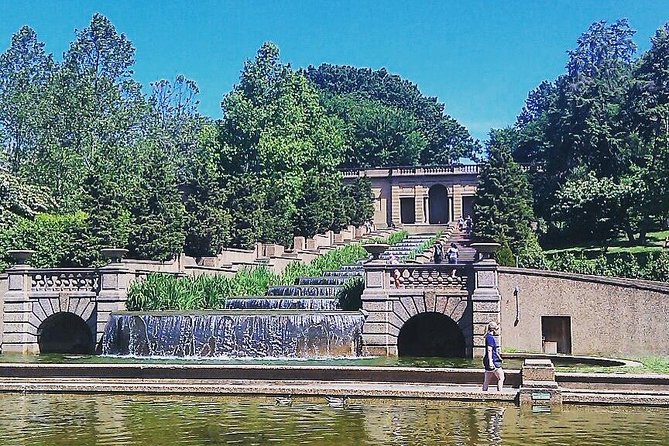
The meeting point is at 1600 Florida Avenue NW, close to Meridian Hill Park. This is a smart place to begin because the park gives you room to understand the setting before the walk moves into denser residential streets.
The first 25 minutes focus on Meridian Hill Park, one of Washington’s most notable urban green spaces. You will not simply cross the park on the way to the next stop. The guide leads you along back paths, points out lesser-known memorials, and explains the woman behind the area’s grand vision.
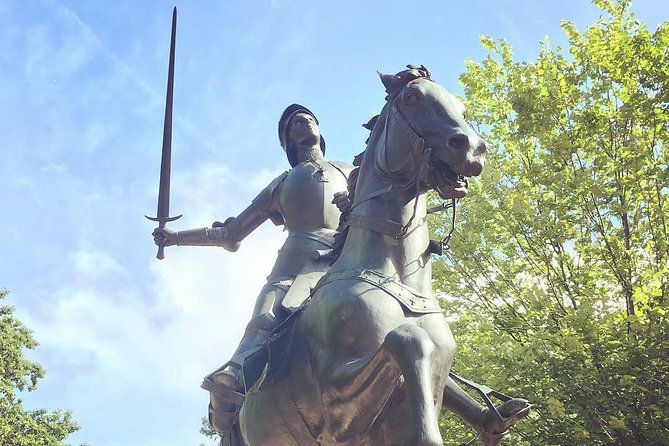
That woman was Mary Henderson, whose plans reached well beyond a pleasant public park. You learn about her idea of creating a diplomatic center in the heights of Washington, with embassies and mansions arranged around the area. This adds useful context to the streets that follow. The buildings are not random decoration. They reflect plans for status, diplomacy, and a more carefully designed part of the capital.
The park section is also a good reminder that Washington is a city of competing visions. The capital may look orderly, but the people who shaped it had strong egos, big hopes, and sometimes impractical plans. A good guide can connect those ambitions to what you see underfoot and along the surrounding streets.
Admission to the park is free. You should still allow enough time to arrive before the start, since the opening stories are part of the tour rather than filler before the main walk.
Other Washington DC tours people book alongside this one:
- DC Memorials Night Tour: Glass-Roof Convertible Upgrade Option
★ 4.5 · 6,933 reviews - National Mall Monuments Night Tour with 10+ Stops, Entry Tickets
★ 4.5 · 4,863 reviews - Washington DC Monuments by Moonlight Tour by Trolley
★ 4.5 · 3,956 reviews
Reading 16th Street beyond the grand address
The experience is described as a 16th Street and Adams Morgan tour, while the route also includes Columbia Heights. That combination gives you a useful look at how Washington’s neighborhoods change within a relatively short distance.
The guide discusses the city’s beginnings as the national capital in 1790, then ties that broader story to buildings and streets in front of you. This is one of the tour’s strongest features. Instead of treating Washington history as a separate lecture, the guide uses the neighborhood to show how political aims, architecture, and city planning worked together.
You can expect close attention to building facades and to the different jobs those buildings have performed over time. A house may have begun as a private residence, served another purpose later, and taken on a new role as the neighborhood changed. Those details help you look at the city with more care. You start noticing not only how a building looks, but also what its past use says about Washington.
The route may appeal especially to anyone interested in architecture, urban planning, or the social history of cities. You do not need specialist knowledge. The point is to give you enough background to notice details you would likely pass without a guide.
Columbia Heights, where the city story gets more personal
Columbia Heights adds a different layer to the walk. Here, the focus is not only on grand plans and impressive facades. The guide also discusses the people, political leanings, diversity, and changes that shaped the neighborhood.
The route is useful because it avoids presenting Washington as a collection of official buildings. You get a look at a lived-in part of the capital, where identity can shift from one block to the next. The guide’s task is to explain those changes without reducing the neighborhood to a simple before-and-after story.
This section also gives you a chance to ask questions. The tour is capped at 20 people, which is not the same as a private walk, but it is small enough for the guide to keep the group together and respond to curiosity. Kim and Carolyn have both been singled out for making the history engaging rather than stiff. Their approach appears to favor conversation and storytelling over memorized speeches.
If you are visiting Washington for the first time, Columbia Heights can provide useful contrast with the capital’s formal core. If you live in the city, you may find the route a good way to put familiar streets into a wider context.
Adams Morgan, full of quirks and layered identities
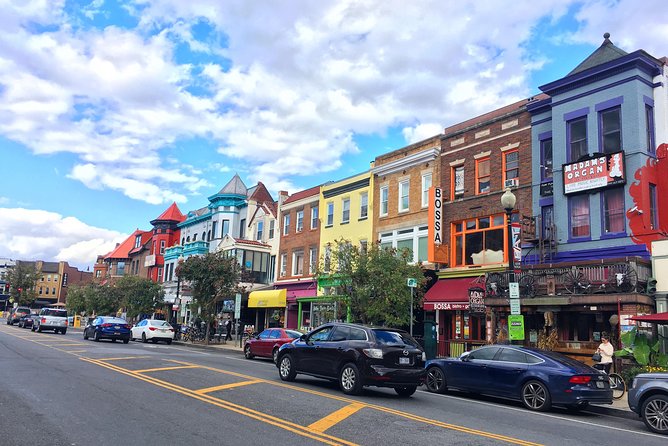
The walk finishes in Adams Morgan, a neighborhood known here for its unusual character, varied architecture, political identity, and cultural mix. The guide explains the area through specific stories and details rather than broad labels.
This is where the tour’s tone becomes especially informal. Adams Morgan has plenty of neighborhood quirks, and the guide uses them to explain how the area developed. You will hear about the people and forces that helped shape its identity, along with the built details that make the neighborhood different from more formal parts of Washington.
The final stretch is not just an ending point. It leaves you in a useful place for the rest of your day. The tour finishes near the intersection of 18th Street and Kalorama Street NW, in the heart of Adams Morgan. That makes it easy to continue walking, find a meal, or explore on your own after the guide has given you a sense of the area.
A practical tip: if you want a restaurant recommendation, save that question for the end. The guides have offered dining suggestions suited to the neighborhood, and you are already in the right place to put one to use.
Same city, a very different couple of hours:
- Hop-on Hop-off Sightseeing Tour by Open-top Bus with 18 Stops
★ 3.5 · 3,848 reviews - Washington DC in One Day: Guided Sightseeing Tour
★ 4.5 · 3,360 reviews - DC Monuments and Capitol Hill Tour by Electric Cart
★ 5.0 · 2,841 reviews - Washington DC Moonlight Tour by Electric Cart
★ 5.0 · 2,610 reviews
Why the human guide matters here
You can find basic facts about Washington on your phone. The value of this tour is the connection between those facts.
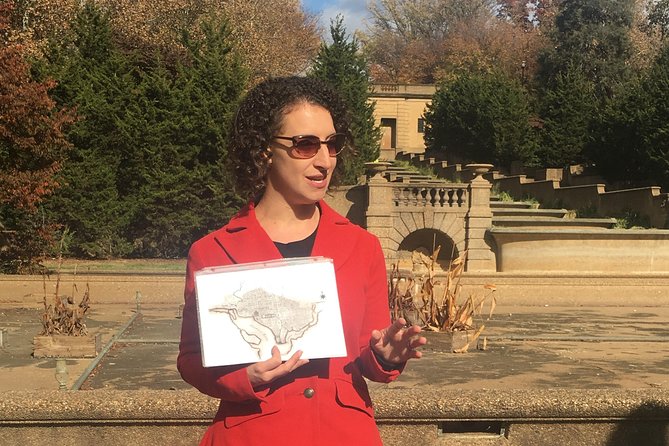
The guides associated with this walk, including Kim and Carolyn, have been praised for storytelling, architecture knowledge, historical depth, and a friendly manner. One guide kept a local resident engaged for two hours with stories about a neighborhood they had lived in for more than 15 years. That is a useful test. If the walk can add something for a longtime resident, it should also give a first-time visitor more than a quick list of dates.
Another appealing feature is the range of subjects. You may move from the founding of Washington as the capital to Mary Henderson’s plans, then to facade details, former building uses, neighborhood politics, and local diversity. The subjects connect because the guide keeps returning to the streets themselves.
The experience may be particularly good for you if you enjoy asking how a place came to look and feel the way it does. It is less suitable if you want a monument-heavy route or a simple checklist of famous sights.
Two hours on foot: what the timing means
The advertised duration is about two hours. That is long enough for a real neighborhood walk, but short enough to fit into a morning or afternoon in Washington.
You should expect steady walking rather than a long stop at one attraction. The first 25 minutes are spent at Meridian Hill Park, with the remaining time used to move through the surrounding neighborhoods and Adams Morgan. Since the route is outdoors and on foot, wear comfortable shoes and be ready for a moderate physical effort.
The walking format is a major advantage. You can see the relationship between the park, residential streets, larger avenues, and the final Adams Morgan blocks. From a vehicle, those connections would be easy to miss. On foot, the changes in architecture and atmosphere happen gradually.
The tradeoff is that the tour does not provide a place to sit for every discussion, and the route may feel tiring if you have already spent the day walking around the National Mall. I would schedule it when you still have energy to pay attention, not as the last item after a full day on your feet.
Price, group size, and practical value
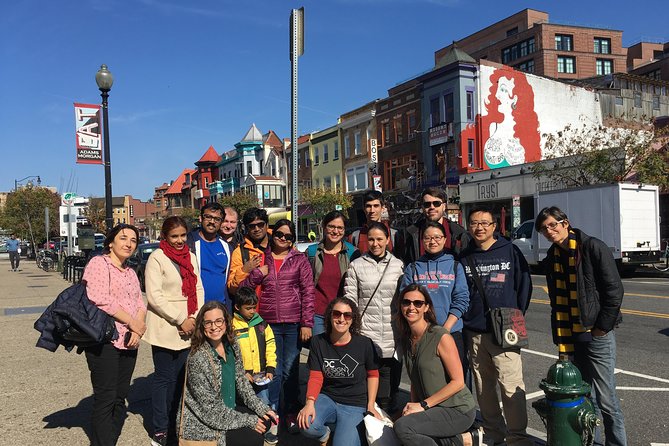
At $48 per person, this is not the cheapest way to spend two hours in Washington. You can walk through these neighborhoods without paying an admission fee, and Meridian Hill Park itself is free.
The price makes more sense if you value interpretation. You are paying for a local guide who can explain why the streets look the way they do, connect the city’s founding to neighborhood development, and point out details you may otherwise miss. For someone interested in architecture, planning, or local history, that added context can be worth more than another general sightseeing loop.
The group maximum is 20 people. That keeps the experience from becoming a large procession, though it is not as personal as a private tour. If you want a private outing, private versions have been available with other groups, but this standard experience is priced per person and has a maximum group size rather than a guaranteed small group.
This tour is often booked about 73 days ahead. That does not mean you must reserve exactly that far in advance, but it does suggest that planning early is wise if your Washington dates are fixed. Confirmation arrives when you book, though the minimum-group rule still applies.
Who will get the most from this walk
I would choose this tour for you if you have already seen the main monuments or want to balance them with a neighborhood experience. It is also a strong pick for repeat visitors, architecture fans, history students, and Washington residents who want to look at familiar streets in a new way.
Families can enjoy it if everyone in the group can manage two hours of walking and listen to historical discussion. The guide’s storytelling approach should help, but this is not a children’s attraction with hands-on activities.
You should also consider it if you like a tour that leaves room for your own exploration. Since you finish in Adams Morgan, you can continue with food, shops, or an unplanned walk instead of returning to the starting point.
I would skip it if your priority is the National Mall, the White House, or major museum interiors. Those are not the focus here. You should also think twice if uneven walking, standing, or a moderate pace would be difficult.
The activity is offered in English, uses a mobile ticket, and allows service animals. It is near public transportation, which helps with reaching the start and leaving the end. Free cancellation is available up to 24 hours before the start time. Cancellations made later are not refunded, and changes made within that period are not accepted.
Should you book the 16th Street and Adams Morgan tour?
Book it if you want Washington beyond the postcard sights. The strongest reasons are the opening at Meridian Hill Park, the attention to architecture, the stories about Mary Henderson, and the way Kim or Carolyn may connect national history with ordinary city blocks.
The $48 cost is fair for a guided walk that adds real context, especially if you would otherwise pass through Columbia Heights and Adams Morgan without knowing what you are seeing. Just arrive ready to walk, reserve ahead if your dates are firm, and keep your afternoon open for Adams Morgan after the tour.
FAQ
How long is the tour?
The tour lasts approximately two hours.
Where does the tour start?
It starts at 1600 Florida Avenue NW, Washington, DC 20009, USA.
Where does the tour end?
It ends in Adams Morgan near the intersection of 18th Street and Kalorama Street NW.
What neighborhoods does the tour visit?
The route covers Meridian Hill Park, Columbia Heights, 16th Street, and Adams Morgan.
Is admission to Meridian Hill Park included?
Meridian Hill Park has free admission.
What language is the tour offered in?
The tour is offered in English.
How many people can join the tour?
The maximum group size is 20 people.
Can I cancel for a full refund?
Yes. You can cancel at least 24 hours before the experience start time for a full refund. Cancellations made less than 24 hours before the start are not refunded.
Recently added around Washington DC
- Small Group Washington DC Night Tour★ 4.5 · 3 reviews
- Washington DC Neighborhoods Personalized Self-Guided App Tour★ 3.5 · 3 reviews
- America’s Main Street and White House Private Full-Day Tour★ 5.0 · 3 reviews
- Beyond the Closet Walking Tour★ 5.0 · 3 reviews
- Pirate Ship Treasure Hunt Cruise with Face Painting★ 4.5 · 3 reviews
- Sushi Masterclass in Washington D.C. (Includes 4-Course Meal)★ 5.0 · 3 reviews
- Private Washington DC Grand Tour with Changing of the Guard.★ 5.0 · 3 reviews
- 250th: National Archives & American History Museum Guided Tour★ 5.0 · 3 reviews
Tours, compared.

DC Memorials Night Tour: Glass-Roof Convertible Upgrade Option
Read our review →
National Mall Monuments Night Tour with 10+ Stops, Entry Tickets
Read our review →
Washington DC Monuments by Moonlight Tour by Trolley
Read our review →
Hop-on Hop-off Sightseeing Tour by Open-top Bus with 18 Stops
Read our review →
Washington DC in One Day: Guided Sightseeing Tour
Read our review →
DC Monuments and Capitol Hill Tour by Electric Cart
Read our review →
Washington DC Moonlight Tour by Electric Cart
Read our review →