
Reviewed · ARLINGTON NATIONAL CEMETERY
Hop-On Hop-Off 21 Stop Trolley Tour + Arlington Cemetery Tour
The most useful feature here is the Arlington National Cemetery connection. Many city sightseeing tours stay around the National Mall, but this one carries you beyond the Potomac to the Kennedy gravesite, Tomb of the Unknown Soldier, Arlington House, and Iwo Jima Memorial. I also like the live narration, which gives the ride a human touch, and the freedom to get off at a museum or memorial instead of viewing Washington only through a window.
The catch is timing. The advertised ride takes about 2 hours 30 minutes, but that is not enough for a full hop-on, hop-off day with museum visits and Arlington. Trolleys are expected about every 30 minutes, yet waits can stretch longer, stops are not always clearly marked, and the final return connections matter. Start early, wear good walking shoes, and treat this as a full-day sightseeing tool.
In This Review
- Key points to know before you ride
- Why this trolley works well for a first day in Washington
- Starting at the Washington DC Welcome Center
- Stops 1 through 5: Downtown, the White House, and Union Station
- Stops 6 through 10: The Capitol, Smithsonian museums, and the Mall
- Stops 11 through 15: The memorial core and downtown museums
- Arlington National Cemetery: the part worth planning around
- Timing problems and how to avoid them
- Price, comfort, and who gets the best value
- The small frustrations you should expect
- Should you book this DC trolley tour?
- FAQ
- How long does the tour take?
- Where does the tour begin?
- How often do the trolleys arrive?
- Is Arlington National Cemetery included?
- What identification is required for Arlington National Cemetery?
- Are children and strollers allowed?
- Can I cancel for a full refund?
Key points to know before you ride

- Arlington adds real value: You can reach major cemetery sights that are awkward to combine with a standard National Mall loop.
- Live guides make the ride lively: Drivers share facts, stories, and directions, with guides such as Rooster and Simone earning special praise for their humor and helpfulness.
- The 21 stops cover the core sights: The route reaches the White House, Capitol, Smithsonian museums, major memorials, and several downtown museums.
- Plan for longer than 2.5 hours: Staying on board gives you an overview, but getting off at several stops can turn the outing into most of a day.
- Trolley pickup takes attention: Some stops have limited signage, and an app showing live vehicle locations is not provided.
- Bring the correct ID for Arlington: US citizens need a state or government photo ID. Foreign visitors must bring a passport. Foreign ID cards are not accepted.
Why this trolley works well for a first day in Washington
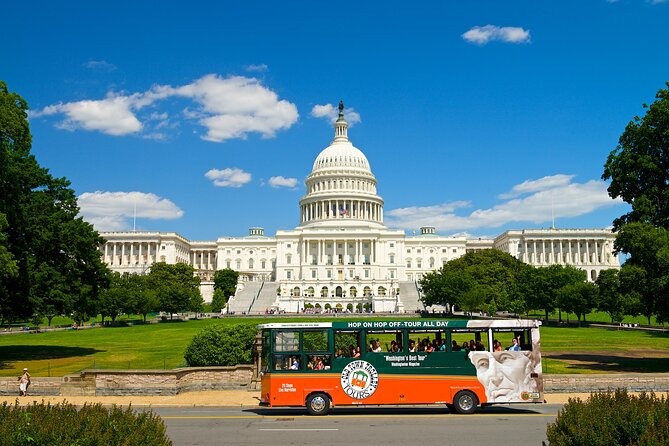
Washington DC is spread out in a way that can fool you. The Lincoln Memorial looks close to the Washington Monument, but the National Mall covers a lot of ground. Add the Capitol, Georgetown side streets, downtown museums, and Arlington across the river, and your feet may start negotiating for a taxi.
This trolley gives you a useful first look. You can listen as you pass the White House, federal buildings, museums, and memorials, then decide where you want to spend more time. I especially like using a ride like this on the first day of a short DC visit. It helps you get your bearings before committing to long walks or complicated parking.
The drivers are part of the experience. Several are described as funny, friendly, and full of local facts. Rooster is singled out for adding unusual details and a strong personality, while Simone receives praise for her Arlington transfers. The quality of narration can vary. One driver was hard to understand because he spoke quickly, and another had trouble being heard over the traffic. There are no headphones or multiple language tracks, so you rely on the live guide in front of you.
That mix of personality and variation is normal for a live tour. If you get a great narrator, the ride becomes far more than transportation. If you do not, you still have a useful route, but you may miss parts of the commentary.
More Arlington National Cemetery tours:
- Arlington National Cemetery Walking Tour & Changing of the Guards
★ 5.0 · 2,566 reviews - Arlington National Cemetery Hop-On Hop-Off Tour
★ 4.5 · 744 reviews - Washington DC: Arlington Nat. Cemetery Ticket & Tram Tour
★ 4.6 · 544 reviews
Starting at the Washington DC Welcome Center
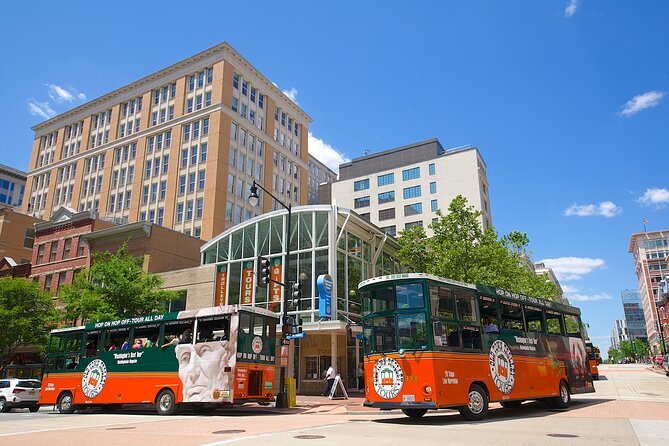
Begin at the Washington DC Welcome Center, near Ford’s Theatre and the Peterson House. This is a practical launch point because you are already close to downtown sights, and the route quickly moves toward Pennsylvania Avenue.
Your mobile ticket makes entry simple, but keep it ready. The service uses transfers and route checks, particularly around Arlington, so do not put your phone away where you cannot find it. A sticker or other tour identification may also make boarding easier, and you should follow the driver’s instructions about where to wait.
The first section gives you a quick look at Ford’s Theatre, the White House area, and nearby government landmarks. It is a good orientation ride, but do not assume you can see every major sight properly without getting off. Washington’s monuments and museums reward time on foot.
Stops 1 through 5: Downtown, the White House, and Union Station
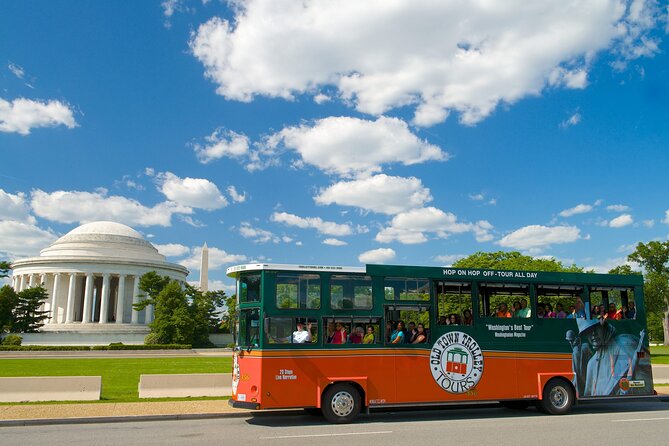
Stop 1 covers the Washington DC Welcome Center, Ford’s Theatre, and Peterson House. Ford’s Theatre is tied to the assassination of Abraham Lincoln, so this stop suits anyone interested in US political history. It is also convenient if you want to begin or end your day downtown.
Stop 2 at 1401 Pennsylvania Avenue NW serves the White House, the White House Visitor Center, and the World War I Memorial. This is one of the most useful early stops for first-time visitors. The White House itself is viewed from outside unless you have separate access, while the visitor center adds displays and context.
Stop 3 at 701 Constitution Avenue NW places you near the National Archives, the West and East galleries of the National Gallery of Art, and the Navy Memorial. This is a strong museum stop. The National Archives appeals to anyone who wants to see foundational American documents, while the National Gallery gives art lovers a reason to leave the trolley for several hours.
Stop 4 at 400 New Jersey Avenue NW includes the Japanese American Memorial and the Hyatt Regency. It is a quieter stop than the White House or Capitol, but it adds a more reflective part of the city’s story. If you get off here, confirm the pickup point before walking away. Stop locations can be easy to miss among other buses and city traffic.
Stop 5 near Union Station serves Union Station and the Smithsonian Postal Museum. Union Station is both a transport hub and a grand civic building, while the Postal Museum is an appealing choice if you want something different from the usual Mall museums. This stop can also help you reach nearby food options, since meals and drinks are not included.
Stops 6 through 10: The Capitol, Smithsonian museums, and the Mall
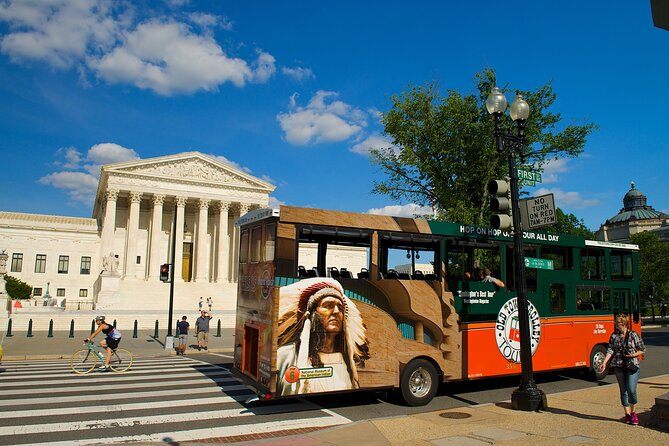
Stop 6 at First Street Southwest is your Capitol stop. From here, you can reach the US Capitol, Botanic Gardens, Supreme Court, and Library of Congress. This cluster deserves careful planning because each place can take longer than expected, and the trolley is not a timed-entry reservation for any of them.
Stop 7 at 600 Independence Avenue Southwest brings you near the National Air and Space Museum, National Museum of the American Indian, and Eisenhower Memorial. The Air and Space Museum is one of the most popular choices in Washington, while the American Indian museum offers a different focus and setting. The Eisenhower Memorial is a convenient addition if you want a memorial stop without crossing the entire Mall.
Stop 8 at 114 Maine Avenue Southwest is listed as a route stop but has fewer named attractions attached to it. I would use it as a flexible connection point rather than make it the center of your day. Ask the driver where the return trolley will collect you before getting off.
Stop 9 at the International Spy Museum gives you an easy way to reach one of DC’s more playful museums. This is a good change of pace after government buildings and war memorials. If you plan to go inside, allow enough time that you are not watching the clock for the next trolley.
Stop 10 at 1398 Independence Avenue Southwest serves the Washington Monument, Smithsonian museums and Castle, and the Holocaust Memorial. This is one of the route’s best all-purpose stops. You can choose a tall national landmark, a museum, or a quiet memorial that asks for more attention than a quick photograph.
The central Mall stops are where the tour becomes a time-management exercise. You can see a great deal from the trolley, but you cannot properly explore several museums and memorials in one short circuit. I recommend choosing one or two places to enter, then using the route for the rest.
More hop-on hop-off bus tickets:
- Washington DC Monuments by Moonlight Tour by Trolley
★ 4.5 · 3,956 reviews - Hop-on Hop-off Sightseeing Tour by Open-top Bus with 18 Stops
★ 3.5 · 3,848 reviews - Washington DC Hop-On Hop-off Trolley Tour with 15 Stops
★ 4.0 · 2,599 reviews - DC: Hop-on Hop-off Tour by Open-top Bus with 17 Stops
★ 4.1 · 1,982 reviews
Stops 11 through 15: The memorial core and downtown museums
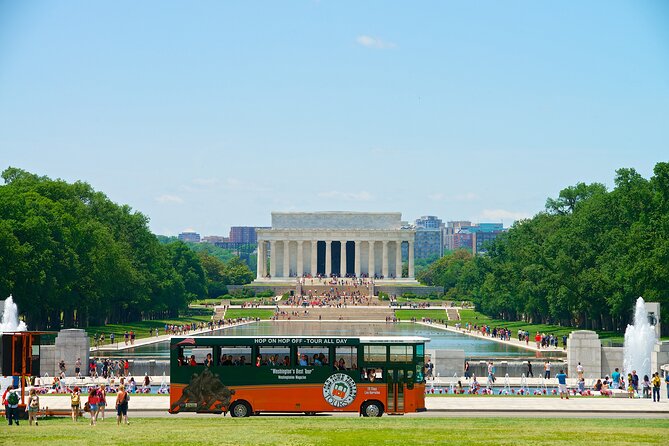
Stop 11 at 16 East Basin Drive Southwest serves the Jefferson Memorial and George Mason Memorial. The Jefferson Memorial sits around the Tidal Basin and is especially rewarding when you want a slower, more open setting. George Mason Memorial is smaller and easier to miss, which makes the trolley useful for linking it with the larger sites.
Stop 12 at 1964 Independence Avenue Southwest reaches the Franklin D. Roosevelt Memorial and Martin Luther King Jr. Memorial. These are substantial outdoor memorials, so plan for walking once you get off. You will not experience them fully from the trolley window.
Stop 13 at 2 Lincoln Memorial Circle is one of the route’s main anchors. It serves the Lincoln Memorial, Vietnam Veterans Memorial, and Korean War Veterans Memorial. This is also the transfer point for the Arlington National Cemetery connection, so pay close attention to what the guide tells you if Arlington is part of your plan.
The Lincoln Memorial area can become confusing because several vehicles may be loading nearby. Ask clearly where to transfer and what destination name the driver uses. One practical lesson from the tour is that a question such as Are you going to Arlington? may not be as clear as Is this the hop-on, hop-off transfer to continue the route? If you are unsure, ask for the exact boarding place.
Stop 14 at 1400 Constitution Avenue NW serves the National Museum of American History and National Museum of African American History and Culture. Both require more than a quick look, so you need to choose between a museum visit and continued sightseeing. This is a worthwhile stop if you have a full day or a second day in the city.
Stop 15 at 800 F Street NW reaches the National Portrait Gallery and American Art Museum. The downtown location makes this a helpful stop when you want art without returning to the Mall. It also gives you a break from the long outdoor walks around the monuments.
Arlington National Cemetery: the part worth planning around
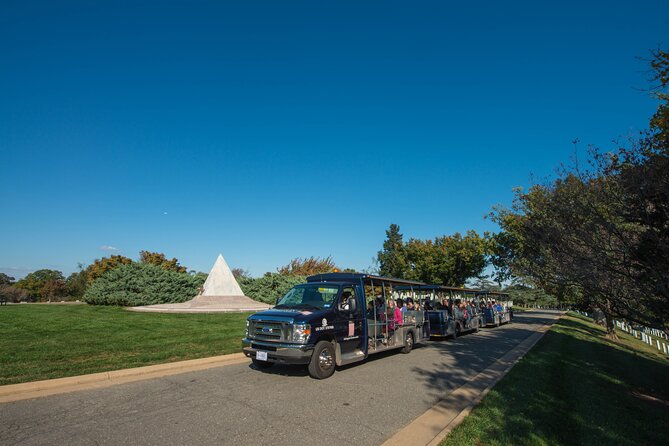
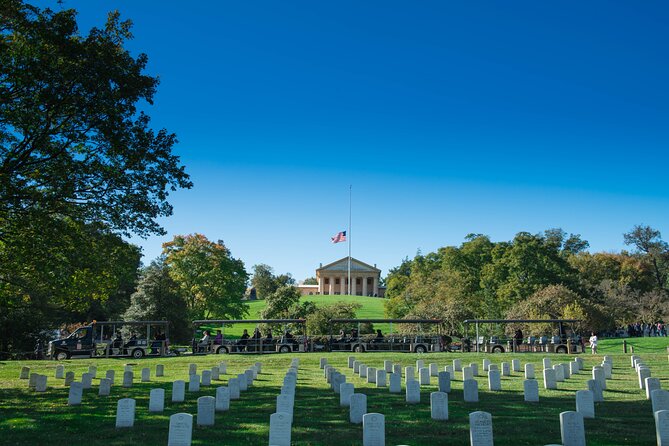
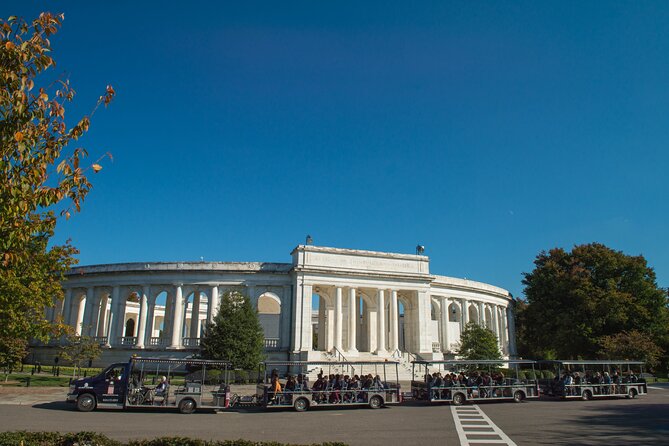
The Arlington section is the strongest reason to choose this package instead of a basic city loop. You transfer from the Lincoln Memorial area to a shuttle serving Arlington National Cemetery. The cemetery has its own internal transport and its own security rules, so the timing is not entirely controlled by the city trolley.
At the Arlington National Cemetery Welcome Center, you can prepare for the cemetery route. Bring the correct identification. Every person entering faces a 100 percent ID check with no exceptions:
- US citizens need a state or government-issued photo ID.
- Visitors aged 16 or 17 may present a valid school ID.
- Foreign visitors must show a passport.
- Foreign ID cards are not accepted.
Stop 17 at the President John F. Kennedy Memorial includes Kennedy’s graveside and the location associated with Supreme Court Justice Ruth Bader Ginsburg. You should expect some walking when you leave the vehicle. The cemetery is not a purely seated sightseeing ride.
Stop 18 in the future expansion area includes the gravesite of General John J. Pershing. This is a more specialized stop, useful if you want military history beyond the most famous monuments.
Stop 19 at the Tomb of the Unknown Soldier is a major highlight. The changing of the guard can be deeply moving, but access and timing depend on the day’s schedule and your arrival time. Do not count on fitting every cemetery stop if you reach Arlington late.
Stop 20 at Arlington House offers a different view of the grounds and the national story connected to the site. The route then reaches Stop 21 at Ord and Weitzel Drive, near the Iwo Jima Memorial outside the gate. The memorial is a strong final stop if your schedule allows, though it may require a separate walk from the main cemetery areas.
Expect stairs, hills, and walking on cemetery stops. The trolley helps people with limited mobility see much more of Washington, but it does not remove all walking. One useful approach is to stay on for the cemetery overview first, then get off only at the stops that matter most to you.
Timing problems and how to avoid them
The published duration of about 2 hours 30 minutes describes the basic experience, not a leisurely day of exploring. If you stay aboard, you can get a broad overview. If you get off at memorials, museums, and Arlington, you need much more time.
Trolleys are scheduled roughly every half hour, but actual waits can vary. Road closures and Washington traffic can slow the service. Drivers have worked around closures well, but delays can still disrupt a carefully packed plan. A serious delay once caused an Arlington visit to become too late to complete properly, so do not schedule your most important cemetery visit at the end of a tight day.
I would use this plan:
- Start as early as possible.
- Pick one or two museums, not five.
- Visit the Mall memorials in a logical group.
- Make Arlington a priority if it matters to you.
- Confirm the pickup point every time you get off.
- Keep a buffer before the last trolley, especially for the return toward Union Station.
The final trolleys may head back around 4 p.m., according to the practical guidance given during the experience. Check the day’s operating details when you board, since missing the last connection can leave you walking farther than planned.
Price, comfort, and who gets the best value
At $59.45 per person, this is not the cheapest way to move around Washington. Public transportation and walking can cost less, especially if you already know the city and are comfortable planning every connection yourself.
The price makes more sense if you value three things: live historical commentary, less time figuring out routes, and the Arlington transfer. Parking in central Washington can be a headache, and driving to the Lincoln Memorial or Mall area may involve construction, restricted access, and repeated loops looking for a place to stop. The trolley removes much of that stress.
It is also a practical choice for families and for anyone who cannot handle a full day of walking. Children three and under ride free, collapsible strollers are allowed, and service animals are permitted. Emotional support animals and pets are not allowed. Most people can participate, but Arlington’s hills and stairs still matter when deciding how much to do on foot.
The best value comes from using it as a full-day framework, not as a quick 2.5-hour ride. If you want to enter multiple museums, a two-day option would likely be easier, though this particular package should not be treated as unlimited time at every attraction.
The small frustrations you should expect
The biggest weakness is route clarity. Some stops have little or no clear signage, and a third-party map has been reported as outdated. You may need to ask a driver or identify the stop by the nearby landmark rather than relying only on a printed map.
There is also no live tracking app included. That means you cannot simply check your phone to see where the next trolley is. Keep your eyes open for the vehicle, wait where the driver directs you, and allow extra time between stops.
Narration quality can change from one driver to another. Many guides are funny and well informed, but fast speech or traffic noise can make the commentary hard to follow. This is not the right tour if you need a perfectly synchronized audio guide in your preferred language.
Still, these are manageable flaws if you stay flexible. The tour works best when you accept that Washington traffic is part of the day and leave room for missed connections.
Should you book this DC trolley tour?
Book it if you are visiting Washington for the first time, want a broad overview, dislike city driving, or especially want Arlington National Cemetery included. I would also recommend it for families and for people who benefit from reducing the amount of walking between far-flung sights.
Skip it if you have only a few hours and need a guaranteed, tightly timed itinerary. It is also less appealing if you already know Washington well and are comfortable using public transportation.
My strongest advice is to make Arlington a planned priority, not an afterthought. Start early, carry the required ID, wear walking shoes, and ask exact questions about every pickup and transfer. Used that way, the trolley gives you a friendly introduction to Washington, useful historical context, and access to a cemetery that is otherwise easy to leave out.
FAQ
How long does the tour take?
The stated duration is approximately 2 hours 30 minutes. If you hop off at museums, memorials, and Arlington National Cemetery, plan for a much longer outing, potentially most of a day.
Where does the tour begin?
You begin at the Washington DC Welcome Center, near Ford’s Theatre and Peterson House.
How often do the trolleys arrive?
Trolleys are expected roughly every 30 minutes, although traffic, road closures, and operating conditions can make waits longer.
Is Arlington National Cemetery included?
Yes. The experience includes transportation to Arlington National Cemetery and a route past major cemetery sights, including Kennedy’s graveside, the Tomb of the Unknown Soldier, Arlington House, and the Iwo Jima Memorial area.
What identification is required for Arlington National Cemetery?
US citizens must provide a state or government-issued photo ID. Visitors aged 16 and 17 may use a valid school ID. Foreign visitors must show a passport, and foreign ID cards are not accepted.
Are children and strollers allowed?
Children three and under are free. Collapsible strollers are allowed on the trolley.
Can I cancel for a full refund?
You can cancel at least 24 hours before the local start time for a full refund. Cancellations or changes made within 24 hours are not accepted for a refund.
Recently added around Washington DC
- Small Group Washington DC Night Tour★ 4.5 · 3 reviews
- Washington DC Neighborhoods Personalized Self-Guided App Tour★ 3.5 · 3 reviews
- America’s Main Street and White House Private Full-Day Tour★ 5.0 · 3 reviews
- Beyond the Closet Walking Tour★ 5.0 · 3 reviews
- Pirate Ship Treasure Hunt Cruise with Face Painting★ 4.5 · 3 reviews
- Sushi Masterclass in Washington D.C. (Includes 4-Course Meal)★ 5.0 · 3 reviews
- Private Washington DC Grand Tour with Changing of the Guard.★ 5.0 · 3 reviews
- 250th: National Archives & American History Museum Guided Tour★ 5.0 · 3 reviews
Arlington National Cemetery, compared.

Arlington National Cemetery Walking Tour & Changing of the Guards
Read our review →
Arlington National Cemetery Hop-On Hop-Off Tour
Read our review →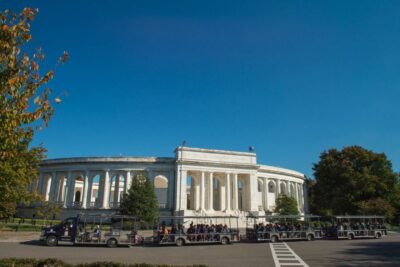

Private Washington DC Tour with Changing of the Guard Ceremony
Read our review →
Small Group Monuments Tour with Changing of the Guard
Read our review →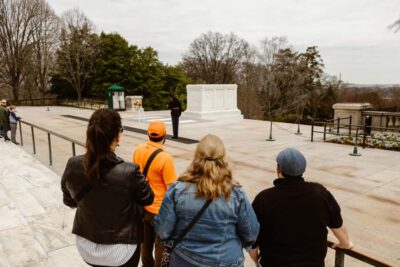
Arlington Cemetery: Kennedy Memorials & Changing of Guard
Read our review →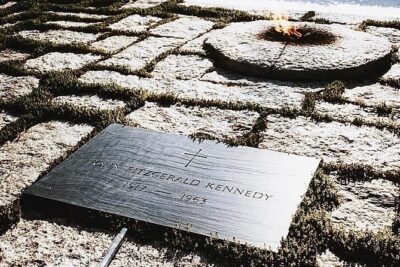
Arlington Cemetery & Changing of the Guard Semi-private 12ppl Max
Read our review →
Day or Night National Mall Bus Tour with Arlington Cemetery Walk
Read our review →Browse the lists this tour appears in