
Reviewed · WALKING TOURS
Harlem Renaissance in DC Walking Tour
Washington’s musical past comes into focus on this two-hour walk through U Street and nearby neighborhoods, where Black Broadway once drew major performers, poets, and audiences. The route links theaters, former clubs, private homes, and the restaurant that still anchors the area’s public life.
I like the way the tour uses real addresses instead of stopping only at polished landmarks. I also like the included break at Ben’s Chili Bowl, which gives you time to buy a drink or a bite while connecting the area’s cultural past with its present-day identity.
The main drawback is that most stops are viewed from outside and receive only a few minutes of formal attention. You need a moderate level of fitness, and the tour requires good weather, so it is best for visitors who enjoy walking and listening rather than entering museums or performance halls.
In This Review
- Key points about this Washington jazz walk
- Why this two-hour walk matters
- Starting at Howard Theatre on T Street
- Duke Ellington’s early steps at Frank Holliday’s Pool Hall
- Lilian Evanti and Washington’s classical music story
- Bohemian Caverns and the old Black Broadway
- Lincoln Theatre’s place in the performance circuit
- Ben’s Chili Bowl, with 25 minutes to eat
- Billie Holiday’s Club Bali on 14th Street
- Poetry and social justice at Georgia Douglas Johnson’s house
- Katie’s presentation style and group size
- Walking pace, weather, and practical comfort
- Who will get the most from this tour
- Is $30 a fair price?
- Should you book the Harlem Renaissance in DC Walking Tour?
- FAQ
- How long is the Harlem Renaissance in DC Walking Tour?
- How much does the tour cost?
- Where does the tour begin?
- Where does the tour end?
- Is food included at Ben’s Chili Bowl?
- Is the tour offered in English?
- How many people can join the tour?
- Can I cancel for a full refund?
Key points about this Washington jazz walk
- Howard Theatre begins the story: Start at the 1910 theater that opened its stage to African American performers.
- Duke Ellington’s early connection: Learn about the former Frank Holliday’s Pool Hall, now the site of Right Proper Brewing Company.
- Black Broadway comes alive: The route includes Bohemian Caverns and Lincoln Theatre, two important names from U Street’s performance era.
- Ben’s Chili Bowl is a real break: You get 25 minutes to purchase refreshments on your own.
- The route honors more than musicians: Lilian Evanti, Georgia Douglas Johnson, and the Saturday Nighter’s Club add opera, poetry, and social justice to the story.
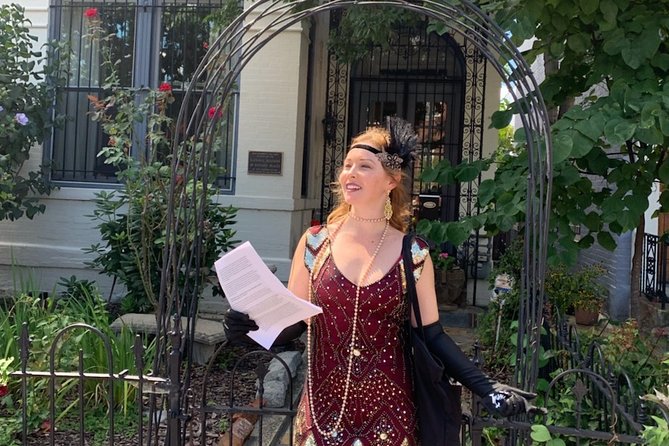
- Small-group format: The maximum group size is 20, and guide Katie brings period costume and music to the presentation.
Why this two-hour walk matters
Washington’s African American cultural story is easy to miss if you stick to the National Mall. This tour shifts your attention north, toward U Street and the surrounding blocks, where performance spaces and private homes helped shape the city’s identity.
I like that the walk does not treat jazz as a single genre with a short list of famous names. The route connects music with opera, poetry, food, and community life. You hear about Duke Ellington and Billie Holiday, but you also learn about Lilian Evanti and the Saturday Nighter’s Club.
The tour costs $30 per person. That is a fair price for two hours with a guide, especially if you want interpretation rather than a self-guided stroll past old addresses. Since the admission tickets at the historic stops are free, you are paying mainly for the research, storytelling, and route design.
You should keep your expectations clear. This is not a ticketed concert, museum visit, or inside tour of every building. Several stops last only three to five minutes, and the sites may be marked mainly by their locations and the stories attached to them.
The overall rating is 4.9 from 36 reviews, with 97 percent recommending the experience. I would read those numbers as a sign that the guide’s delivery is a major part of the value. Katie is singled out for clear commentary, period costume, music, and an ability to make the subject feel immediate.
More walking tours in Washington DC:
- Arlington National Cemetery Walking Tour & Changing of the Guards
★ 5.0 · 2,566 reviews - Ghosts of Georgetown & The Exorcist Steps Walking Tour
★ 5.0 · 610 reviews - Georgetown Foodie Culinary Tour & Neighborhood Walk
★ 5.0 · 437 reviews
Starting at Howard Theatre on T Street
The tour begins at Howard Theatre, 620 T Street NW. Founded in 1910, it was the first theater in Washington, DC, to offer a stage for African American performers.
That makes it a strong starting point. You begin with a building that represents access, opportunity, and public visibility. The theater was not simply a place to watch a show. It helped establish a home for Black performance in a city where many venues excluded African American artists.
You spend about 10 minutes here, with no admission charge. I would use this opening to get oriented and ask questions, because the rest of the tour moves at a steady pace.
The first stop also sets up an important theme: the route is about institutions as much as individual stars. Howard Theatre provides the large public stage, while later stops show where musicians practiced, socialized, lived, and built networks.
Duke Ellington’s early steps at Frank Holliday’s Pool Hall
A short walk brings you to Right Proper Brewing Company, the present-day site of Frank Holliday’s Pool Hall. The stop lasts about five minutes and focuses on Duke Ellington’s early experiments with ragtime and jazz piano.
This is one of the route’s more interesting details because it moves away from the grand theater story. Before Ellington became an internationally known bandleader and composer, he was a young musician learning and testing his craft in local spaces.
The current business is not presented as a historic admission site, and the tour does not include a drink there. The value is in understanding how informal neighborhood places could help launch serious musical careers.
I like this stop because it makes Ellington’s rise feel less distant. You are not only hearing about a finished legend. You are hearing about an early stage in the process, connected to an actual address.
Lilian Evanti and Washington’s classical music story
At 1910 Vermont Avenue NW, the group pauses outside the former home of Lilian Evanti. The stop lasts about five minutes.
Evanti was an African American opera singer who gained acclaim abroad before returning to Washington, DC. Her story broadens the tour beyond jazz and shows how Black artists contributed to classical music as well.
This is an important correction to the usual visitor’s idea of the Harlem Renaissance. The period is often reduced to jazz clubs and literary figures, but artistic life also included opera and formal vocal performance. Evanti’s career helps you see Washington as a place connected to international stages, not only local entertainment.
Because this is a home address rather than a public attraction, you should expect a brief exterior stop. That is not a flaw, but it means the guide’s explanation matters more than the site itself.
Same city, a very different couple of hours:
- DC Memorials Night Tour: Glass-Roof Convertible Upgrade Option
★ 4.5 · 6,933 reviews - National Mall Monuments Night Tour with 10+ Stops, Entry Tickets
★ 4.5 · 4,863 reviews - Washington DC Monuments by Moonlight Tour by Trolley
★ 4.5 · 3,956 reviews - Hop-on Hop-off Sightseeing Tour by Open-top Bus with 18 Stops
★ 3.5 · 3,848 reviews
Bohemian Caverns and the old Black Broadway
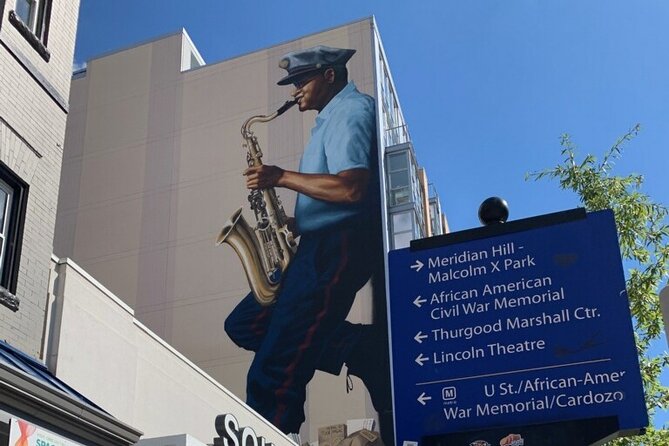
The next stop is Bohemian Caverns, a former jazz venue that was a must-visit during U Street’s era as DC’s Black Broadway. You spend about five minutes here.
The nickname Black Broadway points to the concentration of theaters, clubs, restaurants, and cultural activity that once made this part of Washington a major destination for African American audiences and performers. The route helps you picture how these venues worked together as a district rather than isolated buildings.
Bohemian Caverns is especially useful in that story because it represents the club side of the entertainment world. Howard Theatre offered a formal stage, while venues such as Bohemian Caverns helped define the nightlife and jazz experience along U Street.
Again, the tour treats the location as a historical stop rather than a scheduled performance or interior visit. If you want long periods inside preserved venues, this may feel quick. If you enjoy seeing how a neighborhood fits together, the short stop keeps the route moving.
Lincoln Theatre’s place in the performance circuit
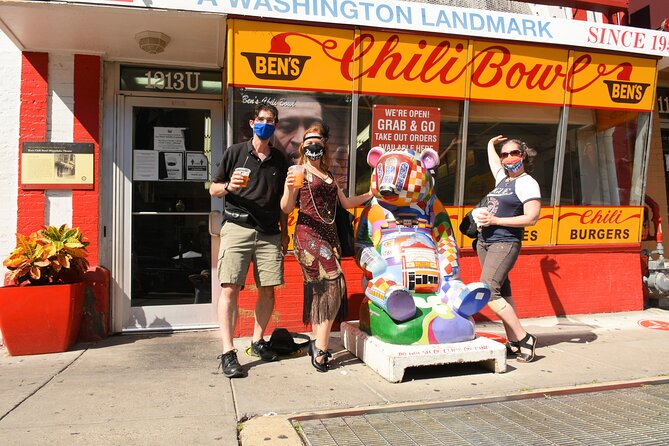
Lincoln Theatre receives about three minutes, making it the briefest theater stop on the route. It was a major theater and show house during the Black Broadway era.
The short timing may seem surprising, but it allows the tour to cover more ground. You see how Lincoln Theatre fits beside Howard Theatre and Bohemian Caverns, creating a chain of performance spaces that supported the district’s cultural life.
I would pay close attention to the contrast between the two theaters. Howard Theatre opens the tour as a pioneering venue, while Lincoln Theatre shows the scale and variety of the later performance circuit.
Three minutes is not enough for an extended architectural study. The point is to place Lincoln Theatre within the larger route, not to provide a full theater tour.
Ben’s Chili Bowl, with 25 minutes to eat
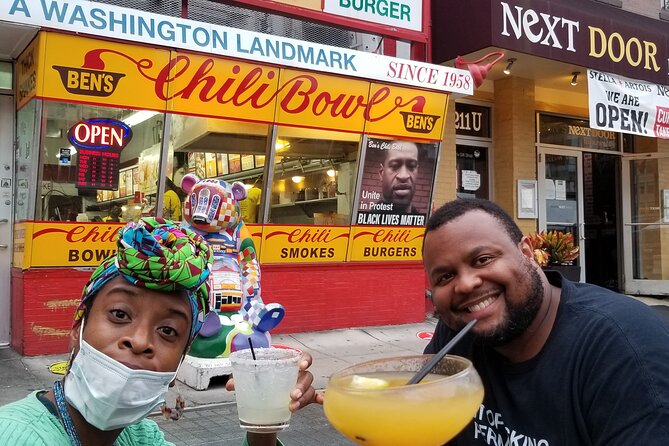
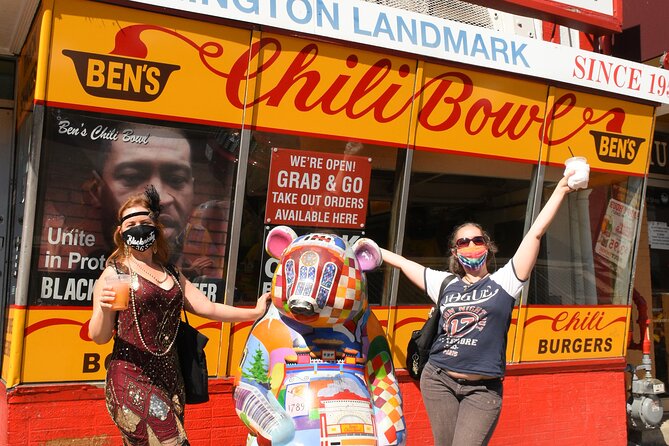
Ben’s Chili Bowl is the longest stop, at about 25 minutes. This is the tour’s refreshment break, but food and drinks are not included in the $30 price.
You can purchase something at Ben’s Chili Bowl or Ben’s Next Door on your own. I like this arrangement because it gives you choice, though you should budget extra money and remember that the stop is not a prepaid meal.
Ben’s has served as an iconic neighborhood eatery for three generations and has welcomed presidents and tourists. Its role here is not just culinary. It helps connect the entertainment district’s past with a place that remains part of Washington’s public life.
This is also your best chance to pause, ask Katie a follow-up question, and reset before the second half of the walk. The stop adds a welcome change of pace after several short exterior explanations.
If you have dietary restrictions or want a full meal, plan carefully. The tour only says that refreshments are available for purchase, so it does not promise a particular menu item, reservation, or amount of eating time beyond the 25-minute break.
Billie Holiday’s Club Bali on 14th Street
At 1901 14th Street NW, the group stops at the former site of Club Bali. The club was a favorite performance spot of Billie Holiday.
This stop brings the story back to a specific performer and venue. Billie Holiday’s name carries enormous weight in jazz, but an address such as this adds a local dimension. You begin to see the city not just as a place where famous artists passed through, but as a network of rooms where they performed and built an audience.
The stop lasts about five minutes. You will likely spend most of that time listening to the story rather than entering a preserved club space, so I would treat the location as a prompt for historical context.
For me, this is one of the route’s strongest connections between a celebrated artist and the neighborhood. It gives the tour a human scale after the broader discussion of theaters and cultural districts.
Poetry and social justice at Georgia Douglas Johnson’s house
The final stop is 1461 S Street NW, the former home of Georgia Douglas Johnson. This house hosted the Saturday Nighter’s Club, where people gathered to discuss poetry, social justice, and Black culture.
The tour ends here, at what is also called the Halfway House. It is a fitting final stop because it takes the story beyond performance. Music matters, but so do the conversations, friendships, and arguments that shape a cultural movement.
I appreciate this ending because it gives the route a wider frame. The Harlem Renaissance was not only about seeing a star on stage. It was also about writers, thinkers, and community members creating spaces to exchange ideas.
The stop lasts about five minutes, and the tour ends at the house. You should plan your onward route from 1461 S Street NW rather than expecting to return to Howard Theatre.
Katie’s presentation style and group size
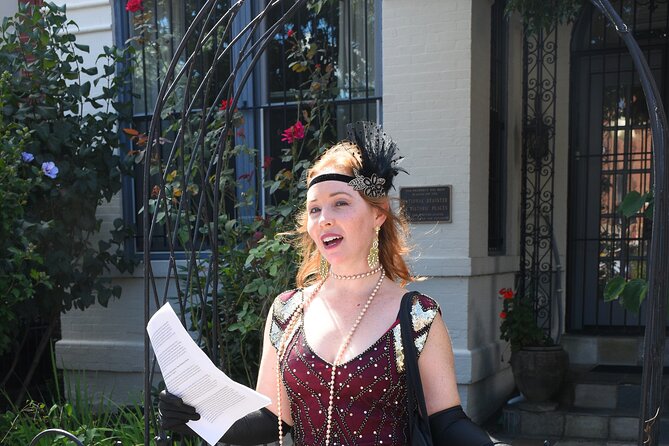
The guide listed for this experience is Katie, and her presentation appears to be a central part of the tour. She uses period costume and music, which can help bring a past era into focus without turning the walk into a formal lecture.
I like the combination of movement, addresses, and performance touches. Music can make the subject easier to remember, while the costume signals that the guide is willing to give the tour a distinct personality.
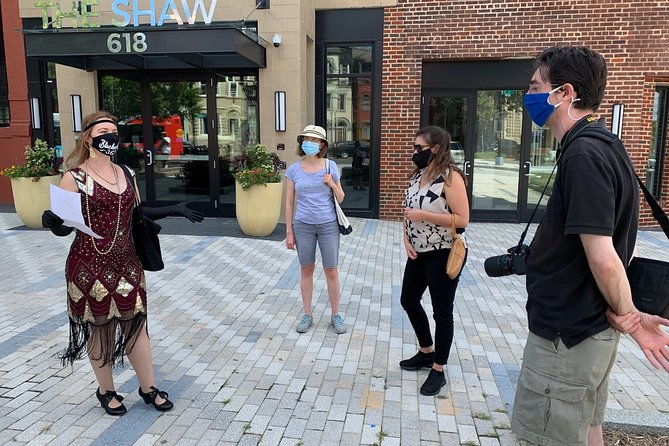
The group maximum is 20 people. That is small enough for a more personal walking experience, though the actual group size can vary. A smaller departure may give you more room to ask questions, while a full group may feel less intimate.
One useful tip is to ask questions as you go. The route covers eight stops in about two hours, and the scheduled time at each location is short. Waiting until the final stop could mean missing the chance to clarify something while you are standing in front of the relevant address.
Walking pace, weather, and practical comfort
The tour requires a moderate physical fitness level. The information does not give an exact mileage figure, so I would prepare for continuous city walking with several stops rather than a leisurely outing in one building.
Wear comfortable shoes and dress for the forecast. The experience requires good weather, and poor conditions can lead to a new date or a full refund. Since the tour takes place outdoors for much of its duration, rain, heat, or cold could affect how much you enjoy the storytelling.
The starting point is Howard Theatre, 620 T Street NW. The end point is 1461 S Street NW, Georgia Douglas Johnson’s House, also called the Halfway House. The route is near public transportation, which makes it easier to fit into a day in Washington without relying on a car.
Mobile tickets are provided, and the tour is offered in English. Service animals are allowed. Free cancellation is available if you cancel at least 24 hours before the start time. Changes or cancellations made later are not accepted for a refund, so check the local start time before making a last-minute adjustment.
The tour requires a minimum number of participants. If that minimum is not reached, you can choose a different date or experience, or receive a full refund.
Who will get the most from this tour
I would recommend this walk to you if you want a focused introduction to Washington’s African American arts history and prefer local streets to indoor exhibits. It is especially useful for first-time visitors who have already seen the National Mall and want a different side of the city.
Families can also find plenty to discuss, particularly if someone in your group is interested in music, documentary work, theater, or social justice. One participant described the tour as useful research for a son’s documentary, and the guide’s willingness to answer questions makes that kind of curious, engaged visit worthwhile.
The experience is also a good choice for people who learn best by moving through real places. Seeing the addresses where performers lived or worked can make the subject more concrete than reading a list of names.
I would think twice if you want extensive interior access, a long meal, or a slow architectural tour. Several stops are only three to five minutes, and refreshments cost extra. The tour is strongest as a guided cultural overview, not as a series of building admissions.
Is $30 a fair price?
At $30, I consider the tour a solid value if you would otherwise have little context for the U Street area. You receive roughly two hours of guided history, eight connected locations, a structured route, and a 25-minute break at Ben’s Chili Bowl.
The price does not cover food or drink, and none of the listed historic stops has an admission charge. That means you should judge the cost by the quality of the guide’s interpretation, not by the number of paid attractions included.
Katie’s use of music and period costume adds something you would not get from simply following addresses on a map. The high 4.9 rating from 36 reviews and 97 percent recommendation rate also suggest that presentation is a major strength.
I would call it good value for a visitor who wants a human story and a manageable introduction. It is less compelling for someone who already knows the U Street district well or wants a full-day history program.
Should you book the Harlem Renaissance in DC Walking Tour?
Book this tour if you want to understand how Washington’s Black cultural life took shape through theaters, clubs, homes, restaurants, and discussion groups. The route gives you specific names and addresses, from Howard Theatre and Lincoln Theatre to Lilian Evanti’s home and Georgia Douglas Johnson’s house.
I especially recommend it if you enjoy music history but want more than a parade of famous performers. The inclusion of opera, poetry, social justice, and neighborhood gathering places gives the walk a useful range.
Skip it if you dislike outdoor walking, need guaranteed indoor access, or expect a full meal to be included. For everyone else, $30 buys a compact, lively introduction to an important part of Washington that sits well beyond the usual monuments.
FAQ
How long is the Harlem Renaissance in DC Walking Tour?
The tour lasts approximately two hours.
How much does the tour cost?
The price is $30 per person.
Where does the tour begin?
The tour begins at Howard Theatre, 620 T Street NW, Washington, DC 20001.
Where does the tour end?
The tour ends at 1461 S Street NW, the former home of Georgia Douglas Johnson, also called the Halfway House.
Is food included at Ben’s Chili Bowl?
No. You have a 25-minute refreshment stop at Ben’s Chili Bowl, but food and drinks at Ben’s Chili Bowl or Ben’s Next Door are purchased separately.
Is the tour offered in English?
Yes. The experience is offered in English and includes a mobile ticket.
How many people can join the tour?
The maximum group size is 20 people.
Can I cancel for a full refund?
Yes, if you cancel at least 24 hours before the experience start time. Cancellations or changes made less than 24 hours before the start time are not refunded, and poor weather or failure to meet the minimum group size can result in a new date or a full refund.
Recently added around Washington DC
- Small Group Washington DC Night Tour★ 4.5 · 3 reviews
- Washington DC Neighborhoods Personalized Self-Guided App Tour★ 3.5 · 3 reviews
- America’s Main Street and White House Private Full-Day Tour★ 5.0 · 3 reviews
- Beyond the Closet Walking Tour★ 5.0 · 3 reviews
- Sushi Masterclass in Washington D.C. (Includes 4-Course Meal)★ 5.0 · 3 reviews
- Pirate Ship Treasure Hunt Cruise with Face Painting★ 4.5 · 3 reviews
- Private Washington DC Grand Tour with Changing of the Guard.★ 5.0 · 3 reviews
- 250th: National Archives & American History Museum Guided Tour★ 5.0 · 3 reviews
Walking Tours, compared.

Arlington National Cemetery Walking Tour & Changing of the Guards
Read our review →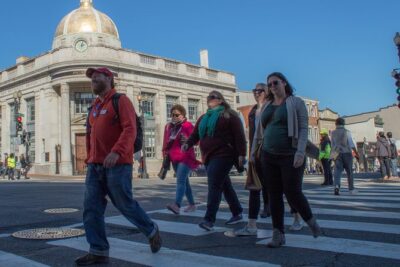
Ghosts of Georgetown & The Exorcist Steps Walking Tour
Read our review →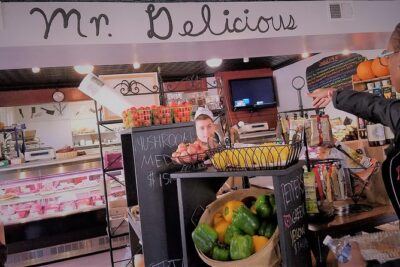
Georgetown Foodie Culinary Tour & Neighborhood Walk
Read our review →
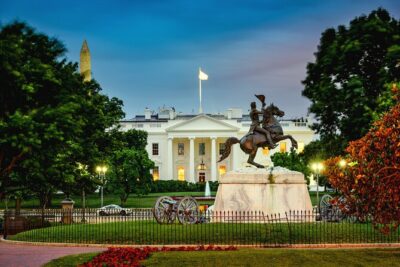
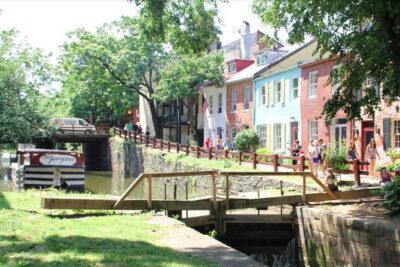
Historic Georgetown: History, Gossip, & Architecture Walking Tour
Read our review →
Smithsonian Museums Walking Tour with Reserved Air & Space Entry
Read our review →
Browse the lists this tour appears in