
Reviewed · MONUMENTS & MEMORIALS
DC Monuments: Small Groups, Big Ideas Walking Tour
The best thing about this National Mall walk is its approach: people first, dates second. Instead of racing from one monument to the next while a guide recites facts, you’ll talk about who these memorials honor, who built them, and what they mean today.
I like the small group of no more than eight people, which gives the conversation room to breathe. I also like the guide, Shelley, a former National Park Service ranger with a master’s degree in museum studies and experience at the Frederick Douglass House, Cape Cod National Seashore, and the Chesapeake and Ohio Canal. The main drawback is simple: you’ll be outside for 150 minutes, walking about a mile, with benches available at some stops but not all.
In This Review
- Key points at a glance
- Why this walk feels different from a monument checklist
- Meeting near the World War II Memorial
- The Washington Monument from a respectful distance
- Reading the World War II Memorial beyond the numbers
- The Vietnam Veterans Memorial and the meaning of The Wall
- The Vietnam Women’s Memorial and the people left out of old stories
- The Three Servicemen statue in five minutes
- The Korean War Veterans Memorial’s moving figures
- Ending at the Lincoln Memorial
- What the two and a half hours really includes
- How Shelley’s background shapes the experience
- Is $85 a fair price?
- Who should book this National Mall walk?
- Final verdict: book it for thoughtful history, not a monument race
- FAQ
- How long does the DC Monuments walking tour last?
- How far will I walk?
- Where does the tour meet?
- Where does the tour finish?
- Is the Washington Monument visited up close?
- Is the tour wheelchair accessible?
- What should I bring?
Key points at a glance
- Former park ranger Shelley leads the walk, bringing experience from seven years with the National Park Service.
- The route connects six major memorial sites, from the Washington Monument area to the Lincoln Memorial.
- The focus is discussion and interpretation, not a fast roll call of presidents, battles, and construction dates.
- A group limited to eight people makes it easier to ask questions and share your own reactions.
- The tour covers about one mile in two and a half hours, with time to pause at each memorial.
- The $85 price buys personal guidance, but it does not include water, snacks, hotel transport, or entry inside the Washington Monument.
Why this walk feels different from a monument checklist

The National Mall can tempt you into collecting sights like stamps. You take a photo at the Washington Monument, walk to the World War II Memorial, glance at the names on the Vietnam Veterans Memorial, and move on. You see a lot, but you may not have much time to think about what you are seeing.
This tour takes a slower, more human approach. Shelley asks you to consider why the monuments exist and how people use them. That matters in Washington, where every statue and inscription carries a message about national memory, sacrifice, leadership, or loss.
The format should suit you if a long string of dates makes your eyes glaze over. The experience is built around conversation, so you can bring your own questions and reactions. It is still structured, with a clear route and set stops, but it does not sound like a lecture delivered at top speed.
A verified rating of 5 from three bookings supports the tour’s strongest quality: thoughtful commentary that feels unhurried rather than corny or mechanical. That is a small sample, so I would not treat it as proof of every possible departure. Still, it fits the tour’s design and Shelley’s background.
More monument and memorial tours in Washington DC:
- DC Memorials Night Tour: Glass-Roof Convertible Upgrade Option
★ 4.5 · 6,933 reviews - National Mall Monuments Night Tour with 10+ Stops, Entry Tickets
★ 4.5 · 4,863 reviews - Washington DC Monuments by Moonlight Tour by Trolley
★ 4.5 · 3,956 reviews
Meeting near the World War II Memorial
The meeting point is on 17th Street Southwest beside a crosswalk near the World War II Memorial, roughly halfway between Independence Avenue and Constitution Avenue. It is on the east side of the street, the side facing the Washington Monument.
If you approach from Constitution Avenue, look for the first crosswalk after the intersection. Shelley wears a green shirt, which gives you a useful visual marker in a crowded part of the Mall.
The start point is practical because the tour begins with a view of the Washington Monument and then moves directly into the memorial route. Give yourself enough time to find the crosswalk and settle in. The National Mall is one of the most visited areas in Washington, and you should expect plenty of people around you.
The supplied starting address is 1750 Independence Avenue Southwest, but the detailed directions point you to 17th Street beside the World War II Memorial. Use the street and crosswalk description when finding the guide.
The Washington Monument from a respectful distance
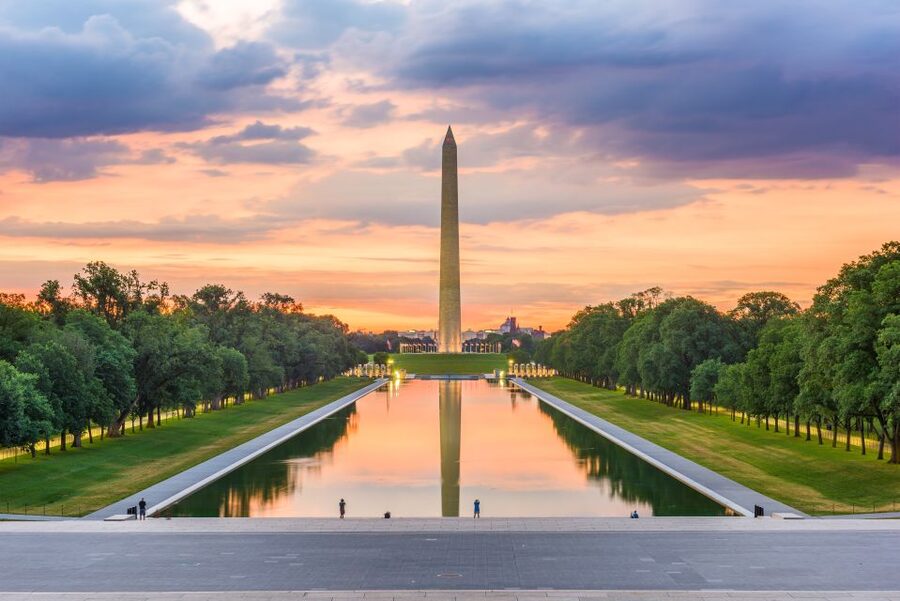
The first stop is the Washington Monument, dedicated to George Washington, the country’s first president. You will view it from a distance rather than go inside.
That distinction matters. If you want to examine the monument up close or visit its interior, do that before the tour. This experience is designed as a walking discussion through the memorials, not as a ticketed visit to the Washington Monument.
From the opening view, Shelley can set up a useful question: what does it mean to create a monument to a national founder? The stop gives you a visual starting point and scenic views as the group begins walking, but it is brief, listed at about 15 minutes.
If the Washington Monument is your top priority, plan extra time before the walk. If your main goal is understanding the memorials as a group, the distant view works well and keeps the tour moving.
Reading the World War II Memorial beyond the numbers
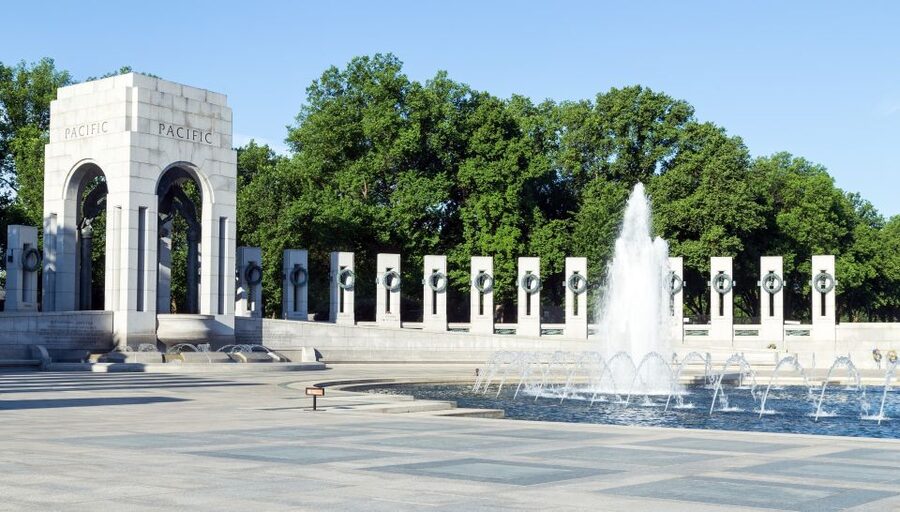
The World War II Memorial honors the 16 million people who served in the United States Armed Forces, the millions who supported the war effort at home, and the 405,399 Americans who died.
Those numbers are important, but the tour’s stated purpose is to move beyond numbers. You’ll discuss the service members, the people on the home front, and the choices involved in deciding how a nation remembers a war.
You have about 25 minutes here. That is enough time for a focused explanation and a few questions, though not enough to inspect every detail at length. Bring your camera, since the memorial offers strong photo opportunities, but try not to let photography replace the conversation.
This is also one of the more open portions of the route, so the group may encounter many other people. Shelley’s small group format should help keep the discussion personal, even in a busy public setting.
More walking tours in Washington DC:
- Arlington National Cemetery Walking Tour & Changing of the Guards
★ 5.0 · 2,566 reviews - Ghosts of Georgetown & The Exorcist Steps Walking Tour
★ 5.0 · 610 reviews - Georgetown Foodie Culinary Tour & Neighborhood Walk
★ 5.0 · 437 reviews - Gastronomic Georgetown Walking Food Tour
★ 4.5 · 373 reviews
The Vietnam Veterans Memorial and the meaning of The Wall
The Vietnam Veterans Memorial is the emotional center of the walk for many people. It includes three parts: the Vietnam Veterans Memorial Wall, the Three Servicemen statue, and the Vietnam Women’s Memorial.
At The Wall, the focus turns to how the memorial was created and how it is used today to honor those who died during the Vietnam War. This is not simply a stop for a photograph. The design invites a different kind of encounter, and Shelley’s approach gives you time to consider why the memorial has remained meaningful.
The Wall is listed for about 25 minutes, the longest single portion of the Vietnam section. That extra time is welcome. You can listen, look closely, and think about the difference between a memorial that celebrates victory and one that centers loss.
The setting can be quiet and serious, but the tour is not presented as a solemn performance. The point is to discuss how public memory works and why people visit. You should come ready to be respectful and attentive.
The Vietnam Women’s Memorial and the people left out of old stories
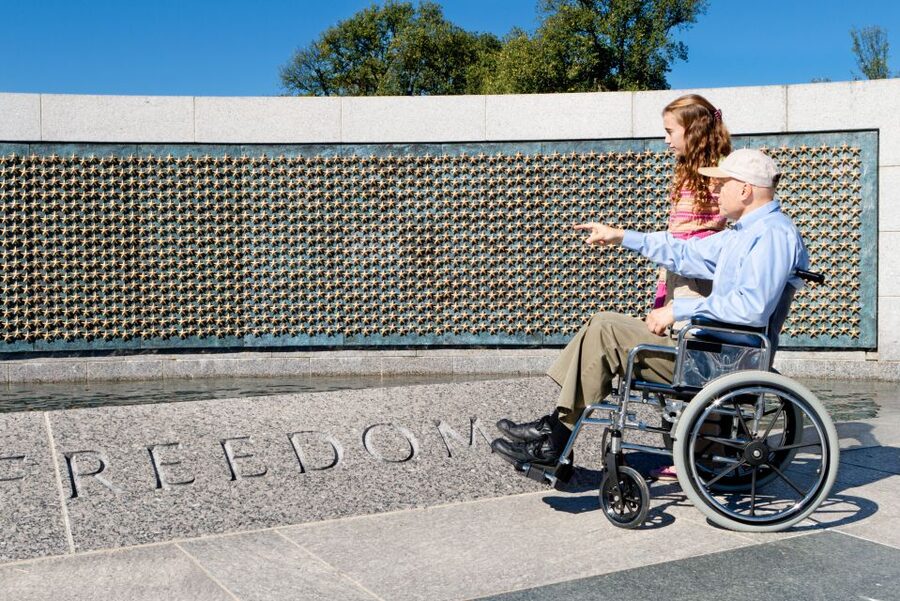
The Vietnam Women’s Memorial receives its own 10-minute visit. Its inclusion helps widen the story beyond the most familiar images of soldiers and combat.
The memorial recognizes women connected to the Vietnam War, and this stop gives Shelley a chance to talk about whose service becomes visible in public memory. Ten minutes is not a long time, but it prevents the monument from being treated as an afterthought.
I like this part of the route because it matches the tour’s larger promise: focus on people, not just official dates. You move from the broad national story at the World War II Memorial to the personal and often overlooked roles represented here.
The Three Servicemen statue in five minutes
The Three Servicemen statue is a short stop, listed at about five minutes. It is part of the Vietnam Veterans Memorial complex and adds a more direct, figurative representation of military service.
Because this stop is brief, expect a compact explanation rather than a long discussion. It works as a bridge between the Wall, the Women’s Memorial, and the Korean War Veterans Memorial.
The sequence is useful. You see different ways of representing service and sacrifice within one memorial area, from names on a wall to a statue of living figures. That contrast gives the tour more substance than a simple stop at one famous monument.
The Korean War Veterans Memorial’s moving figures
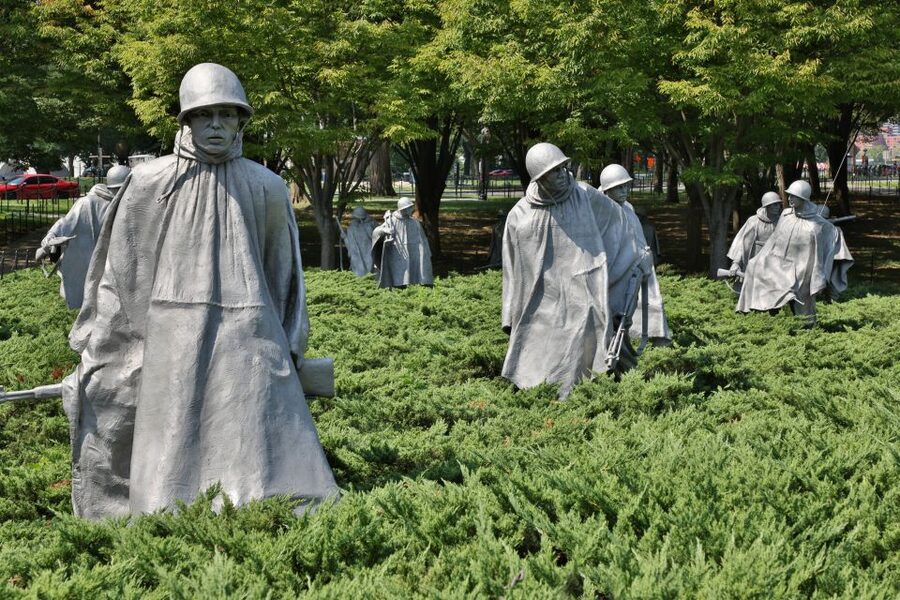
The Korean War Veterans Memorial honors the millions of Americans and allied partners who fought during the Korean War. Its memorial includes 19 service member statues and a Wall of Remembrance.
The figures create a very different visual experience from the Vietnam Wall. Instead of a long surface of names as the main focus, you encounter patrol figures moving across the site. Shelley’s 20-minute discussion can help you think about how design changes the way a memorial feels.
The Wall of Remembrance also broadens the focus to include the scale of the conflict and the allied contribution. This is a good stop for visitors who know less about the Korean War than about World War II or Vietnam.
As with the other outdoor sites, you may find crowds around the memorial. The tour does not promise isolation, and the National Mall is rarely empty. The benefit of the small group is not silence. It is the chance to stay connected to the guide and the discussion.
Ending at the Lincoln Memorial
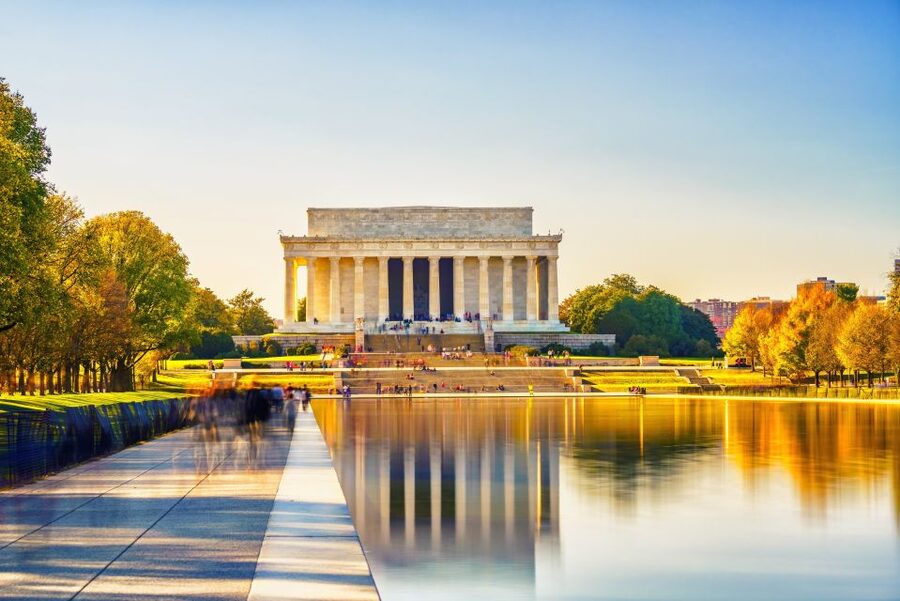
The tour ends at the Lincoln Memorial, dedicated to Abraham Lincoln, the nation’s 16th president. Lincoln led the country through the Civil War and played a crucial role in ending slavery.
This is a strong final stop because it brings the tour back to leadership, national conflict, and the question of what a country chooses to honor. The experience allows about 15 minutes here, enough for a guided discussion and time to take in the memorial.
Ending at the Lincoln Memorial also gives you a useful place to continue your day. You are not returned to the starting point, so plan your next movement from there. The finish is especially convenient if you want to spend more time at the Lincoln Memorial or continue exploring the nearby monuments on your own.
The stop can be crowded, and the large steps may require patience when people are taking photographs. Still, it is a memorable place to finish a route built around national ideals and the human cost of preserving them.
What the two and a half hours really includes
The listed duration is 150 minutes. The scheduled stop times add up to roughly 115 minutes, leaving time for walking, transitions, questions, and scenic views.
That pacing is one of the tour’s strengths. You are not being hurried through every site. At the same time, this is not a full-day examination of the National Mall. You will see a carefully chosen group of memorials, not every monument in the area.
The walk covers about one mile, or 1.6 kilometers. That distance is manageable for many people, but the outdoor conditions and the standing matter as much as the mileage. There are benches, but not at every stop. Comfortable shoes and water are essential.
Bring a reusable bottle. Refill stations are available along the National Mall, while bottled water is not included. Snacks are also your responsibility, and you will be outside for the entire tour.
The activity is wheelchair accessible, but it is not recommended for people with back problems. If you need frequent seating, consider that benches are not guaranteed at each memorial.
How Shelley’s background shapes the experience
Shelley’s professional background is a real part of the tour’s value. Seven years with the National Park Service means she has worked in places where history is presented to the public every day. Her master’s degree in museum studies and bachelor’s degrees in anthropology and linguistics also fit the tour’s focus on people, interpretation, and language.
You should not expect a dry academic seminar. The description points to an interactive walk where the group talks about why the monuments exist and what they mean to each person. Shelley’s role is not just to deliver information. She guides the group toward questions that make the sites more personal.
That approach will suit you if you enjoy asking questions or comparing your own reaction with other people’s views. It may suit you less if you want a silent walk, a strict timeline, or an exhaustive list of architectural details.
The tour is conducted in English. With a maximum of eight participants, you should have a better chance to hear clearly and speak up than you would on a large coach or a crowded public tour.
Is $85 a fair price?
The cost is $85 per person. That is not the cheapest way to see the National Mall, since you can walk among these memorials without paying an admission fee.
The value comes from the interpretation and the small group. You are paying for 150 minutes with a professional guide, a planned route, historical context, and time to discuss the memorials rather than simply locate them. Shelley’s National Park Service experience adds credibility and practical skill.
For a first visit to Washington, the price makes more sense if you want help making connections between the sites. It is less compelling if you already know the memorials well or prefer to explore alone with a guidebook.
All fees and taxes are included. Hotel pickup, food, and bottled water are not. Since the tour stays outdoors, the extra costs are minor, but you should bring water and a snack rather than expect refreshments along the way.
Who should book this National Mall walk?
I would point this tour toward people who want meaningful context without a date-heavy lecture. It should work well for adults, families with older children, and curious first-time visitors who want a guide to explain the human stories behind the stone and bronze.
It is also a good choice if you dislike large tour groups. Eight people is small enough for questions and conversation, while still giving the walk a social feel.
You may want a different experience if your priority is going inside the Washington Monument, covering every major site on the Mall, or avoiding outdoor walking. This tour has no indoor portion, no hotel transportation, and no promise of a bench at every stop.
Free cancellation is available up to 24 hours before the tour, and you can reserve now while paying later. Those policies make it easier to fit the walk into a changing Washington schedule.
Final verdict: book it for thoughtful history, not a monument race
Book this tour if you want the National Mall to feel like a conversation about people and memory rather than a list of dates. The small group, Shelley’s background, and unhurried pace give the $85 price a reasonable case.
Skip it if you only want quick photo stops or need a fully seated experience. For everyone else, this is a well-shaped introduction to the World War II, Vietnam, Korean War, Washington, and Lincoln memorials, with enough time to look up from your camera and think about what they mean.
FAQ
How long does the DC Monuments walking tour last?
The tour lasts 150 minutes, or two and a half hours.
How far will I walk?
You should be prepared to walk about one mile, or 1.6 kilometers.
Where does the tour meet?
Meet on 17th Street Southwest beside a crosswalk near the World War II Memorial, about halfway between Independence Avenue and Constitution Avenue. It is on the east side of the street, facing the Washington Monument. The guide wears a green shirt.
Where does the tour finish?
The tour ends at the Lincoln Memorial.
Is the Washington Monument visited up close?
The tour views and discusses the Washington Monument from a distance. If you want to see it up close, you should do so before the tour.
Is the tour wheelchair accessible?
Yes, the activity is wheelchair accessible. Benches are available at some stops, but not every stop, and the experience is not recommended for people with back problems.
What should I bring?
Bring comfortable shoes, water or a reusable water bottle, and snacks. Refill stations are available on the National Mall. You should also bring your curiosity and a camera.
Recently added around Washington DC
- Small Group Washington DC Night Tour★ 4.5 · 3 reviews
- Washington DC Neighborhoods Personalized Self-Guided App Tour★ 3.5 · 3 reviews
- America’s Main Street and White House Private Full-Day Tour★ 5.0 · 3 reviews
- Beyond the Closet Walking Tour★ 5.0 · 3 reviews
- Pirate Ship Treasure Hunt Cruise with Face Painting★ 4.5 · 3 reviews
- Sushi Masterclass in Washington D.C. (Includes 4-Course Meal)★ 5.0 · 3 reviews
- Private Washington DC Grand Tour with Changing of the Guard.★ 5.0 · 3 reviews
- 250th: National Archives & American History Museum Guided Tour★ 5.0 · 3 reviews
Monuments & Memorials, compared.

DC Memorials Night Tour: Glass-Roof Convertible Upgrade Option
Read our review →
National Mall Monuments Night Tour with 10+ Stops, Entry Tickets
Read our review →
Washington DC Monuments by Moonlight Tour by Trolley
Read our review →
DC Monuments and Capitol Hill Tour by Electric Cart
Read our review →
National Mall Night Tour with 10+ Monuments (Public or Private)
Read our review →
Monuments by Moonlight Nighttime Trolley Tour
Read our review →
Washington Monument Direct Entry with Guidebook
Read our review →
No-Wait Washington Monument Direct Entry Tickets & Guidebook
Read our review →Browse the lists this tour appears in